Commercial Restoration in North Las Vegas
24/7 commercial restoration in North Las Vegas and surrounding areas. IICRC-certified, insurance billing accepted. Call (702) 633-5033.
Water pooling under a server room raised floor or smoke settling into HVAC returns after hours doesn’t wait for a convenient time to show up, and neither does the cost of downtime. A flooded retail floor or a smoke-damaged office suite isn’t just a property problem, it’s a revenue problem the moment the doors can’t open. Desert Valley Restoration answers 24/7 for commercial water damage, commercial fire damage, and the restoration work that gets a business back to operating instead of just back to dry.
What commercial restoration actually involves
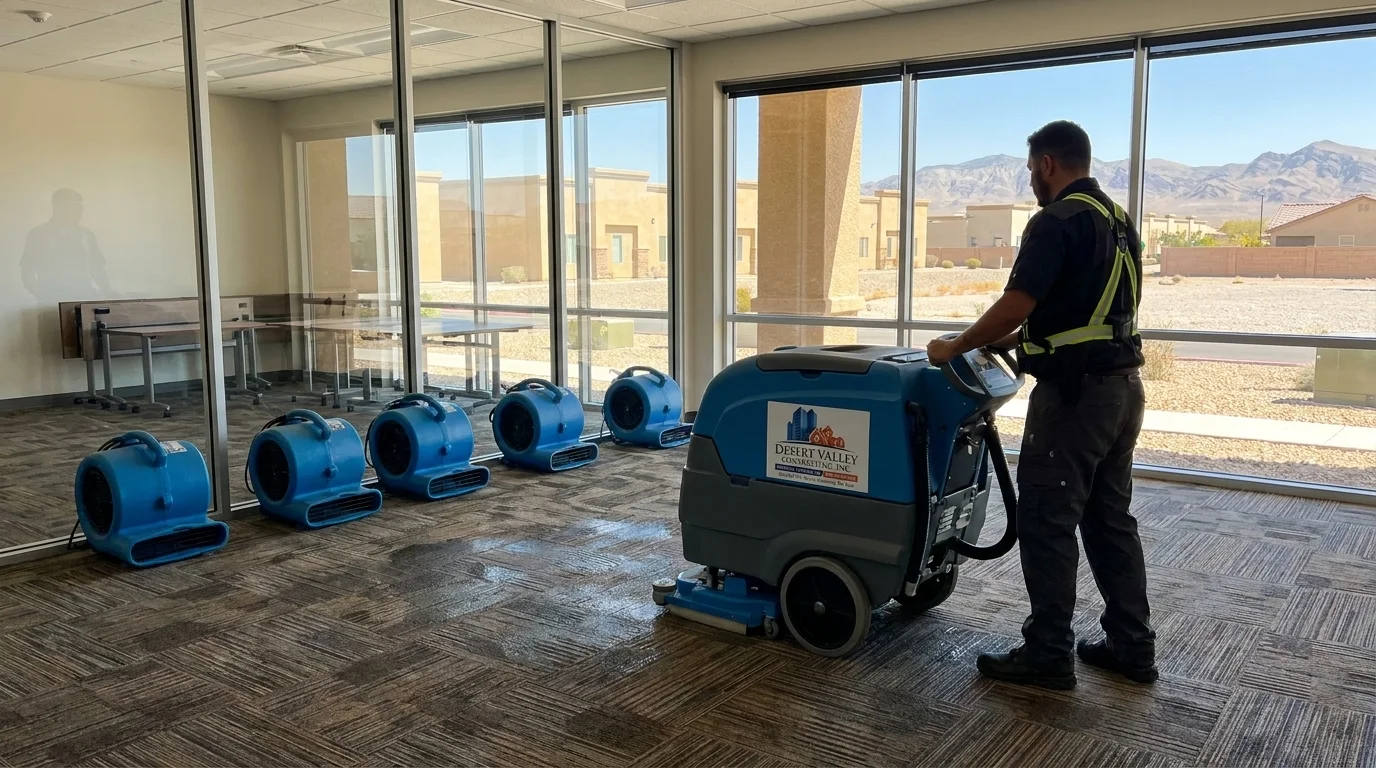
Commercial restoration covers the same underlying physics as residential water and fire damage, extraction, drying, soot removal, odor control, but the constraints are different. A loss in an office suite, retail storefront, warehouse, or multi-tenant building has to account for lease terms, tenant improvement finishes, server rooms, point-of-sale systems, inventory, and the fact that part of the building often needs to stay open while another part is under containment. Equipment scales accordingly: commercial-grade desiccant dehumidifiers for large open floor plans, negative air machines to isolate work zones from occupied space, and moisture mapping across suspended ceilings, raised flooring, and HVAC plenums where water and smoke travel further than they do in a typical house. Timelines depend on square footage and loss category, but phased work, drying one zone while another stays operational, is standard on commercial jobs in a way it rarely is on residential ones.
Our process
- Triage and life-safety assessment. Before anything else, we identify what’s structurally unsafe, what’s electrically live, and what can be isolated so unaffected parts of the building keep functioning.
- Extraction or soot and smoke removal. Standing water gets pulled first; for fire losses, we characterize the soot type, protein residue from a kitchen fire behaves very differently than synthetic soot from burned plastics and electronics, before selecting a cleaning method.
- Containment and phased drying. We section off active work areas with poly barriers and negative air pressure so retail customers, office staff, or warehouse crews can continue using unaffected space while drying equipment runs.
- Moisture monitoring and air quality checks. Daily readings through drywall, subfloor, and HVAC returns confirm drying progress and catch moisture that’s migrated into spaces the initial loss didn’t visibly touch.
- Documentation for property management and insurance. Photos, moisture logs, and scope notes go into a report built for a commercial adjuster or a property manager who needs to justify the claim to ownership or a tenant.
What separates a good commercial restoration response from a bad one
The biggest mistake on commercial losses is treating the whole building like one undifferentiated space. A crew that doesn’t section off the affected area ends up shutting down more square footage than necessary, which costs the business more in downtime than the restoration itself. Another common miss is skipping moisture checks above the ceiling grid or under raised flooring, both are common in commercial buildings and both hide moisture that resurfaces as mold weeks later. On fire losses, operators who don’t correctly identify soot type often use the wrong cleaning agent, which can smear protein residue instead of lifting it or fail to neutralize odor from synthetic materials. Adjusters reviewing commercial claims look closely at whether drying equipment placement and runtime match the documented moisture readings, and whether the contractor separated the claim into categories, structure, contents, business interruption, that align with how the policy is actually written.
What does commercial restoration cost?
Commercial restoration costs vary more than residential work because they depend on square footage, occupancy type, and whether the business needs partial access maintained during the job. Every loss gets a written scope before work begins, since a one-room office suite and a 10,000 square foot warehouse aren’t priced the same way. Commercial property insurance typically covers the restoration and drying portion of a covered water or fire loss, and often business interruption coverage if the policy includes it, though contents and inventory loss may fall under a separate line.
| Scenario | Typical range |
|---|---|
| Small office suite, clean water, single room | $2,000 - $5,500 |
| Retail storefront, water extraction and drying | $4,500 - $15,000 |
| Office suite, smoke and soot cleaning | $6,000 - $20,000 |
| Warehouse, large-area water extraction | $10,000 - $35,000+ |
| Multi-tenant building, phased drying with partial occupancy | $15,000 - $50,000+ |
| Commercial kitchen fire, protein soot cleanup | $8,000 - $25,000 |
Seasonal & regional considerations
North Las Vegas summers push commercial HVAC systems hard, and a rooftop unit failure or condensate line backup during peak heat can soak ceiling tile and insulation in a commercial space within hours. Flat and low-slope commercial roofs common in the valley’s industrial and retail buildings are also more vulnerable to ponding during the region’s short, intense monsoon storms, which shows up as water intrusion around rooftop units and parapet walls rather than obvious roof damage from the ground.
Service area
Desert Valley Restoration is based in North Las Vegas and handles commercial water and fire damage restoration throughout the surrounding Las Vegas Valley, including the industrial corridors, retail centers, and office parks that make up much of the area’s commercial building stock.
If your business has standing water, smoke damage, or a loss that needs to stay contained while the rest of the building keeps running, call Desert Valley Restoration to schedule a commercial restoration assessment.
Services We Handle
- Commercial Building
- Commercial Projects
Frequently Asked Questions
Does commercial property insurance cover water and fire damage restoration?
Can part of our building stay open while restoration work is happening?
What's the difference between protein soot and synthetic soot in a commercial fire?
How does moisture get checked in spaces like suspended ceilings or raised flooring?
What documentation do you provide for property managers and commercial adjusters?
Looking for the best commercial restoration company in North Las Vegas?
Desert Valley Restoration provides licensed and insured commercial restoration in North Las Vegas, NV and the surrounding area, and has served local property owners since 2000. Customers rate us 4.3 out of 5 stars across 95 Google reviews. We answer calls 24/7 — call (702) 633-5033 for immediate help.
Need Commercial Restoration now?
We respond 24/7 across North Las Vegas and surrounding NV cities.
Related Coverage
- Our Restoration Services
- Large Loss and Catastrophic Response in North Las Vegas
- 24/7 Emergency Water Damage Restoration in North Las Vegas
- 24/7 Emergency Fire Damage Restoration in North Las Vegas
- Contact Desert Valley Restoration
- Restoration Services in Blue Diamond
- Restoration Services in Boulder City
- Restoration Services in Enterprise
- Restoration Services in Henderson
- Restoration Services in Indian Springs
- Restoration Services in Las Vegas
- Restoration Services in Moapa Town
- Restoration Services in Moapa Valley
- Restoration Services in Mount Charleston
- Restoration Services in Nelson
- Restoration Services in Pahrump
- Restoration Services in Paradise