Large Loss and Catastrophic Response in North Las Vegas
24/7 large loss and catastrophic response in North Las Vegas and surrounding areas. IICRC-certified, insurance billing accepted. Call (702) 633-5033.
When a loss stops being a single room with a dehumidifier and becomes a multi-story commercial building with water tracking through three floors, or a fire that takes out an entire wing of a multifamily property, the response has to change shape. Large loss and catastrophic response in North Las Vegas means mobilizing multiple crews, managing a claim that may run into seven figures, and coordinating with adjusters, engineers, and general contractors who are all watching the same clock. This is not a scaled-up version of a residential job. It is a different discipline with its own documentation standards and staffing math.
What large loss and catastrophic restoration actually involves
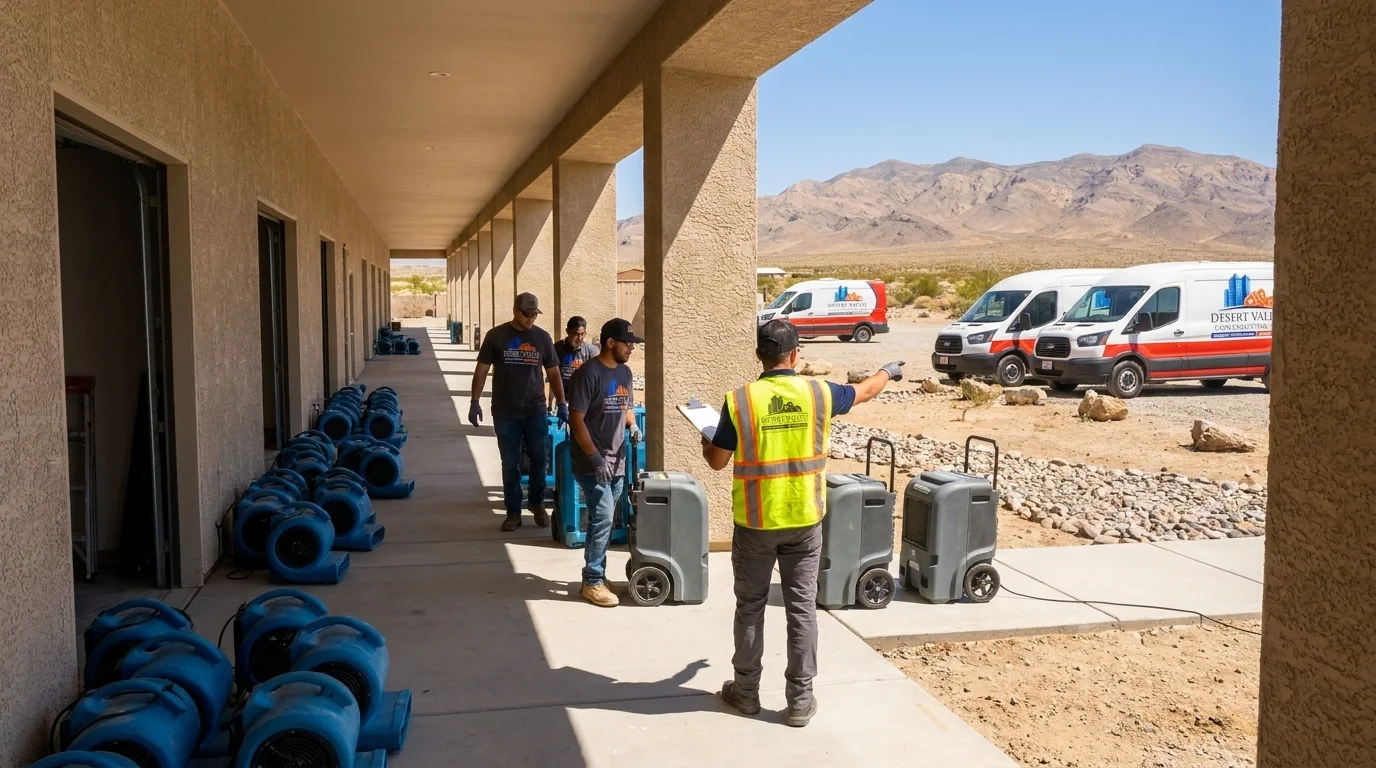
A catastrophic loss typically involves more than one affected structure or floor, damage that crosses multiple trades (water, fire, structural), or a claim size that triggers carrier-level large loss review. That could be a hotel with a burst main that floods four floors overnight, a warehouse fire that destroys racking and inventory alongside the building envelope, or storm damage that hits an entire apartment complex at once. The work pulls in extraction equipment, commercial-grade desiccant dehumidification, thermal imaging for moisture mapping across large footprints, and often a structural engineer’s sign-off before reconstruction can begin. Timelines run weeks to months rather than days, and the mitigation phase alone may require a dozen or more technicians working in shifts.
Our process
- Incident mobilization and scoping. Crews and equipment are staged based on the scale of the loss, with an incident lead assigned to coordinate trades, access, and safety protocols before work begins.
- Full-property documentation. Every affected unit, floor, or zone is photographed and moisture-mapped individually, because large loss adjusters need a defensible, itemized record rather than a general summary.
- Phased mitigation. Water extraction, containment, and drying are run in parallel across zones rather than sequentially, so one wing isn’t sitting wet while another dries.
- Structural and trade coordination. Where fire or water has compromised framing, flooring, or electrical, findings are routed to the structural engineer or general contractor handling reconstruction so scope doesn’t get discovered twice.
- Ongoing monitoring and reporting. Drying logs, air quality checks, and progress reports are issued on a schedule the adjuster and property manager can track for the life of the project.
What separates a good large loss response from a bad one
The most common failure on a catastrophic job is under-resourcing it like a residential loss, one or two technicians trying to cover a building that needed ten. That leads to moisture sitting in wall cavities long enough for secondary damage, and it shows up later as mold claims the adjuster didn’t budget for. The second failure is documentation that’s too thin for the claim size: large loss adjusters expect room-by-room or unit-by-unit photo logs, psychrometric readings, and a written scope, not a one-page summary. A strong response also means someone is actively managing the sequence between mitigation and reconstruction trades so drying equipment isn’t still running when framing crews need access, and so reconstruction isn’t delayed waiting on a moisture clearance that should have been scheduled days earlier.
What does large loss and catastrophic restoration cost?
Costs on catastrophic losses scale with the number of units or floors affected, the category of water or extent of fire damage, and how much reconstruction follows mitigation. These are typical industry ranges for reference, not a quote; every loss gets a written scope from Desert Valley Restoration before work begins. Commercial property insurance typically covers mitigation and reconstruction tied to a covered peril, though large losses usually involve a dedicated adjuster and a more detailed proof-of-loss process.
| Scenario | Typical range |
|---|---|
| Mid-size commercial building, water loss | $75,000 - $250,000 |
| Multi-unit residential property, fire loss | $200,000 - $750,000 |
| Large retail or industrial facility, storm damage | $150,000 - $500,000 |
| Hotel or multifamily property, combined fire and water damage | $500,000+ |
| Warehouse with structural and contents loss | $300,000 - $1,000,000+ |
Seasonal & regional considerations
North Las Vegas and the surrounding valley see most large-scale water losses during monsoon season, roughly July through September, when fast-moving storms overwhelm drainage around commercial roofs and parking structures in a short window. Summer heat also compresses drying timelines in some ways (faster evaporation) and complicates them in others, since HVAC systems are often already strained or damaged in the loss itself. Fire losses tend to spike in the dry, windy months of late spring, where low humidity lets a contained fire spread faster through a structure before suppression.
Service area
Desert Valley Restoration responds to large loss and catastrophic events throughout North Las Vegas and the broader valley, including Las Vegas, Henderson, Summerlin, and surrounding commercial corridors. Multi-site losses that span more than one property are coordinated under a single project lead regardless of how many addresses are involved.
If you’re managing a loss that’s bigger than a single unit or a single trade can handle, get a large loss scope started now. Call Desert Valley Restoration at (702) 633-5033 to begin incident mobilization and documentation before the damage compounds.
Frequently Asked Questions
Does insurance cover large loss and catastrophic restoration?
What actually qualifies a claim as a large loss versus a standard restoration job?
How do you coordinate with large loss adjusters and general contractors on a multi-building property?
How long does a catastrophic restoration project typically take from mitigation to reconstruction?
What kind of staffing and equipment does a catastrophic loss actually require?
Looking for the best large loss and catastrophic response company in North Las Vegas?
Desert Valley Restoration provides licensed and insured large loss and catastrophic response in North Las Vegas, NV and the surrounding area, and has served local property owners since 2000. Customers rate us 4.3 out of 5 stars across 95 Google reviews. We answer calls 24/7 — call (702) 633-5033 for immediate help.
Need Large Loss and Catastrophic Response now?
We respond 24/7 across North Las Vegas and surrounding NV cities.
Related Coverage
- Our Restoration Services
- Contact Desert Valley Restoration
- Restoration Services in Blue Diamond
- Restoration Services in Boulder City
- Restoration Services in Enterprise
- Restoration Services in Henderson
- Restoration Services in Indian Springs
- Restoration Services in Las Vegas
- Restoration Services in Moapa Town
- Restoration Services in Moapa Valley
- Restoration Services in Mount Charleston
- Restoration Services in Nelson
- Restoration Services in Pahrump
- Restoration Services in Paradise