TL;DR: The best mold remediation company in North Las Vegas does three things every job: finds and fixes the water source causing the mold (not just the mold itself), contains the work area so spores don’t spread to the rest of the house, and verifies the fix with post-remediation testing before calling it done. Look for an IICRC-certified firm with a mold-specific credential (AMRT), a Nevada contractor’s license, and a written scope that names the source repair, not just the cleanup.
If you just pulled back a baseboard in a North Las Vegas home and found dark staining behind it, or your air conditioner’s evaporator coil has been dripping into the attic insulation for who knows how long, you’re not dealing with a humidity problem. In the Las Vegas Valley, mold almost never shows up because the air is damp. It shows up because something leaked: a slab plumbing line, an AC drain pan, a water heater, or monsoon rain that found its way through a roof penetration. That distinction matters when you’re picking a company, because a crew that treats the symptom without finding the leak is setting you up for round two.
What should you actually look for in a mold remediation company?
The company you hire should be able to show you an IICRC Certified Firm status, a mold-specific technician credential such as AMRT (Applied Microbial Remediation Technician), and an active Nevada contractor’s license before they touch a wall. Desert Valley Restoration carries an IICRC Certified Firm designation, IICRC AMRT mold certification, and holds Nevada license 0072652-B & B6, verifiable through the Nevada State Contractors Board.
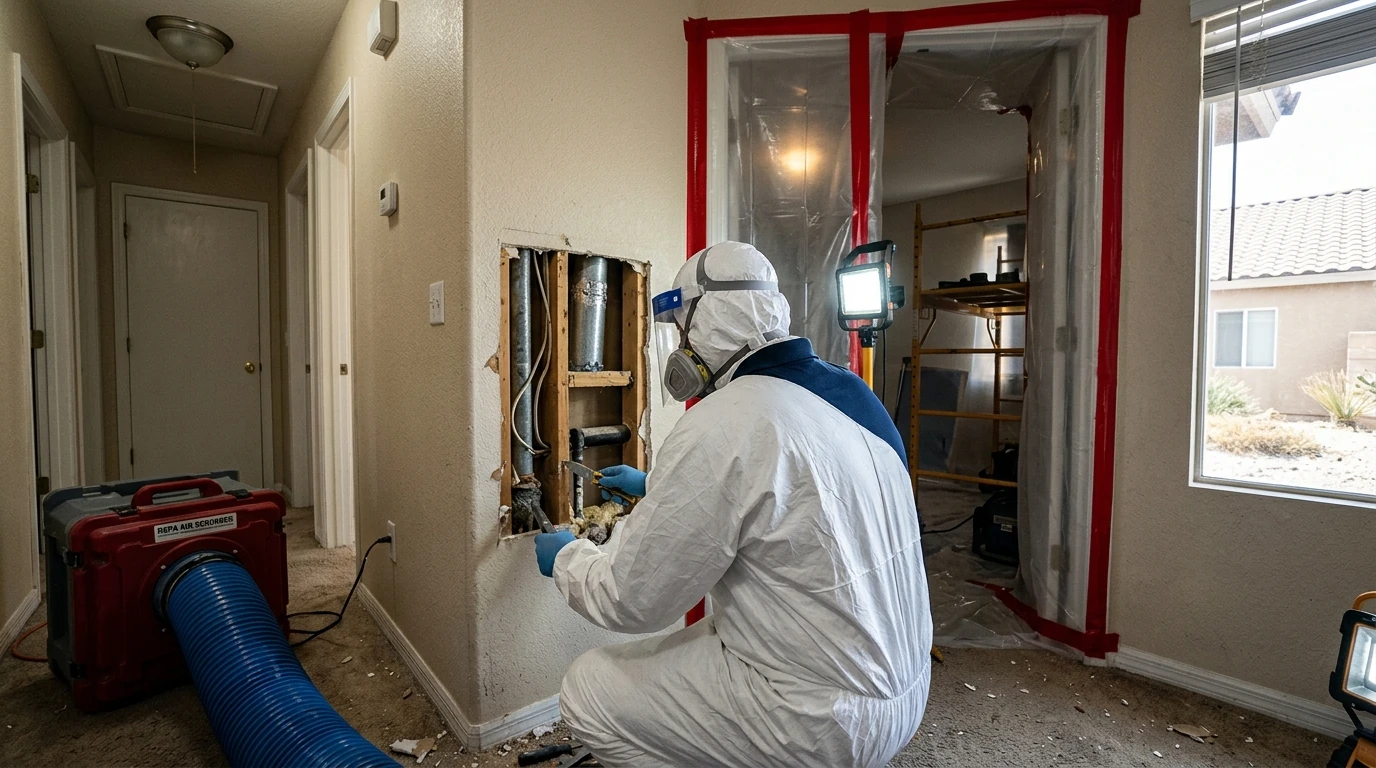
Beyond paperwork, ask how they diagnose the moisture source before they start demo. A contractor who walks in, quotes a flat price to “remove the mold,” and never asks about your AC drain line, your water heater’s age, or whether you’ve had a slab leak, is treating the wrong problem. The remediation itself (containment, HEPA filtration, removal of porous materials) follows the ANSI/IICRC S520 Standard for Professional Mold Remediation, but S520 explicitly starts with correcting the moisture source. Skip that step and the mold comes back, usually inside six to twelve months.
Mold remediation vs. mold removal: is there actually a difference?
Yes: “mold removal” usually means wiping or spraying visible mold off a surface, while remediation means correcting the moisture source, containing the area, removing contaminated porous materials, and verifying the air and surfaces are clear afterward. Removal alone treats what you can see. Remediation treats the whole problem, including what’s inside the wall cavity or under the flooring where you can’t see it.
This is the gap that trips up homeowners who call a general handyman or a carpet-cleaning outfit for a “mold job.” They’ll bleach a patch of drywall, it looks clean for a few weeks, and the growth returns because the wet insulation behind that drywall was never touched. A company that scopes the job properly will often tear out affected drywall, insulation, and sometimes flooring, treat the framing, and only then close the wall back up.
What questions should you ask before signing a scope of work?
Ask these four questions and listen for specific answers, not reassurance: What is the moisture source, and how will it be fixed or referred out? Will the work area be contained with negative air pressure? What materials are being removed versus treated in place, and why? How will you verify the job is done: visual check only, or air/surface clearance testing?
A company that can’t name the moisture source hasn’t actually diagnosed your problem yet, they’re pricing a cleaning job. Containment matters because cutting into moldy drywall without sealing the room can push spores into HVAC returns and spread the contamination to rooms that were previously clean. And “how do you verify it’s done” separates a company that stands behind its work from one that wants to get paid and leave.
How do you know the mold problem is actually fixed afterward?
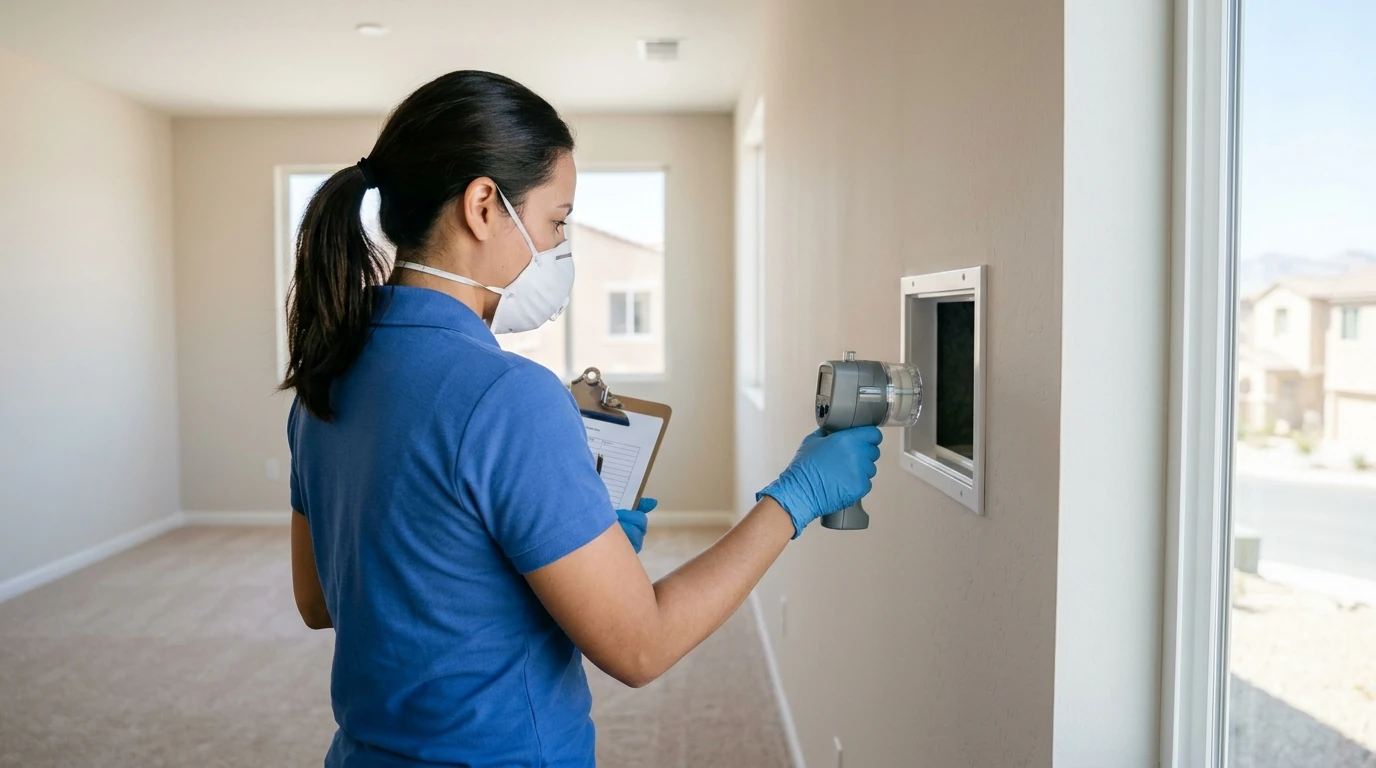
The only reliable way to confirm a remediation job worked is post-remediation verification, either a visual clearance inspection or lab-based air and surface sampling compared against a baseline. A reputable company will offer this as a distinct step, sometimes performed by a third party to avoid any conflict of interest, before they consider the job closed.
If hidden mold is part of what brought you here, our guide on signs of hidden mold walks through what to check behind baseboards, under cabinets, and around AC lines before you even call anyone. And if you’re trying to confirm what you’re looking at before committing to remediation, see how to test for mold for the difference between a DIY kit and a lab-grade inspection.
In North Las Vegas specifically, the moisture sources worth checking first are the AC evaporator coil and drain line (common in summer when units run nonstop), slab plumbing leaks in older homes on grade, water heater connections, and roof penetrations that let monsoon rain in during late summer storms. Mold grows fast once materials are wet: the EPA notes it can start within 24 to 48 hours on a damp surface, so the window between “we found a leak” and “we have a mold problem” is short.
What should you do next?
Start with a mold inspection that identifies the moisture source and the extent of the growth, in writing, before any remediation work begins. That written scope is what protects you if the problem turns out to be bigger than the visible stain, or if you need documentation for an insurance claim.
Desert Valley Restoration has worked on water and mold losses in the North Las Vegas area since 2000, holds an IICRC AMRT mold certification alongside its IICRC Certified Firm status, and answers calls 24/7. Schedule a mold inspection by calling Desert Valley Restoration at (702) 633-5033, or request a written scope before any demo starts.
If the mold followed a recent leak rather than a slow one, it’s worth pairing the mold assessment with a look at water damage restoration so the drying and the remediation are handled as one coordinated job instead of two separate calls.
About Desert Valley Restoration
Desert Valley Restoration is an IICRC Certified Firm serving North Las Vegas, NV and the surrounding valley since 2000, holding Nevada contractor’s license 0072652-B & B6. The company’s technicians carry IICRC credentials across water, fire and mold work, including AMRT for mold remediation, and the firm is rated 4.4 stars from 96 Google reviews. Desert Valley Restoration handles mold remediation, mold inspection and testing, water damage restoration, and related reconstruction work across North Las Vegas, Las Vegas, Henderson, and the wider region.