Mold Inspection and Testing in North Las Vegas
24/7 mold inspection and testing in North Las Vegas and surrounding areas. IICRC-certified, insurance billing accepted. Call (702) 633-5033.
If a room smells musty after you close the door for a few hours, or you’ve had a slab leak, roof leak, or AC condensation problem in the last year, the question isn’t whether mold might be growing somewhere behind the drywall. It’s whether you can prove what’s actually in the air before you spend money on remediation, repairs, or a real estate transaction that hinges on a clean bill of health. Mold inspection and testing gives you that documentation: a defensible, lab-backed answer instead of a guess.
What mold inspection and testing actually involves
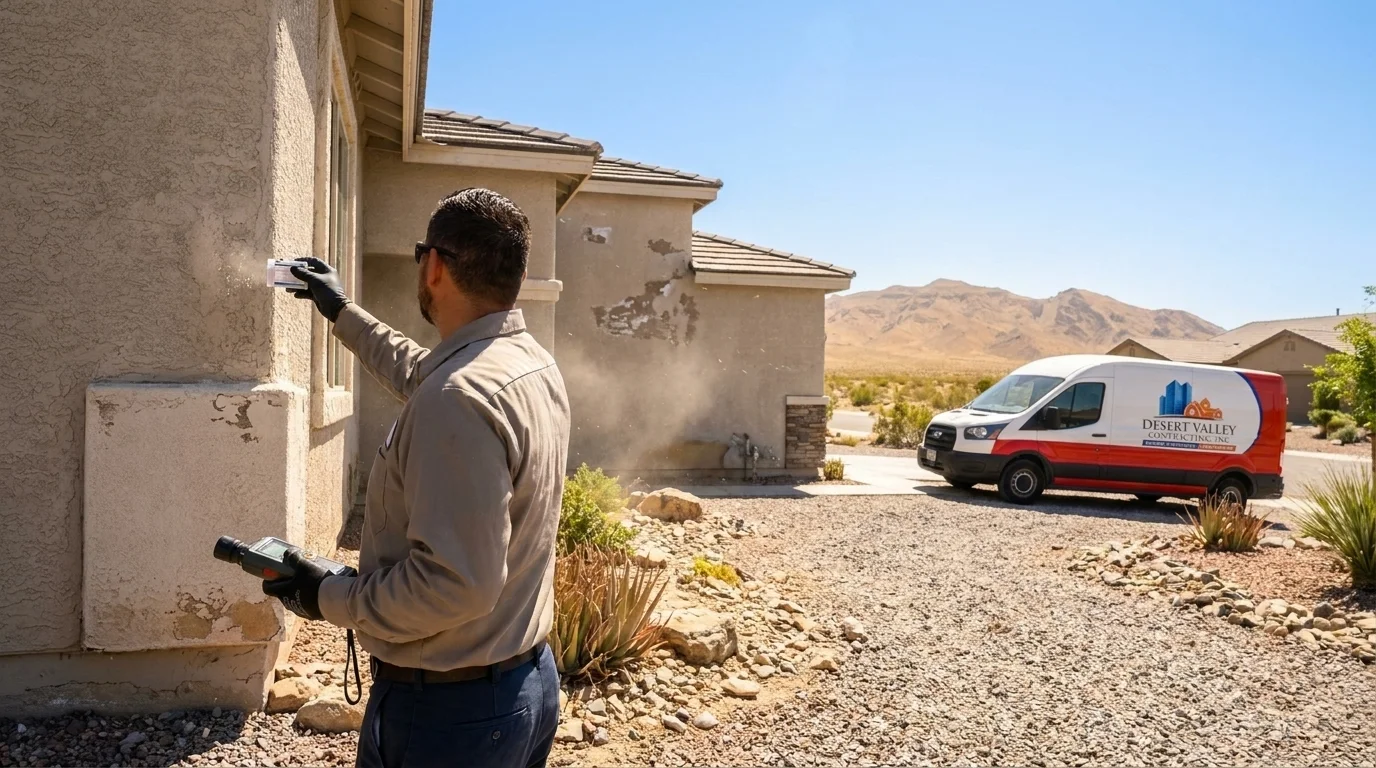
A proper mold assessment starts with a visual inspection of the property, moisture mapping with a meter or thermal camera to find hidden damp spots behind walls, under cabinets, or around window frames, and a conversation about the home’s history (past leaks, flood events, humidity complaints, HVAC issues). From there, testing branches into two categories: air sampling, which captures spore counts from the air in a given room compared against an outdoor baseline, and surface sampling (tape lifts or swabs), which confirms what a specific patch of visible growth actually is. Samples go to an independent, accredited lab, not an in-house lab, which matters for insurance and real estate credibility. Turnaround on most lab results runs a few business days. The whole on-site portion of a standard inspection typically takes one to two hours depending on the size of the property and how many samples are pulled.
Our process
- Intake and history review. We ask about recent leaks, water intrusion, musty odors, or health complaints tied to specific rooms, since that narrows where we look first.
- Visual inspection and moisture mapping. Moisture meters and thermal imaging locate damp framing, subfloor, or wall cavities that aren’t visible at the surface.
- Sample collection. Air samples establish spore counts indoors versus outdoors; surface swabs or tape lifts confirm the identity of visible growth when present.
- Independent lab analysis. Samples go to a third-party accredited laboratory, not graded in-house, so the results hold up for insurance claims or real estate disclosures.
- Written report and recommendations. You get a clear report with lab findings, photos, moisture readings, and, if remediation is warranted, a scope of work our IICRC AMRT-trained team can carry out.
What separates a good mold inspection from a bad one
The most common shortcut is skipping moisture mapping and going straight to air sampling. Spore counts without knowing the moisture source behind them tell you there’s a problem but not where it’s coming from or whether it’s getting worse. Another mistake is relying on a single air sample in one room and calling it a whole-house assessment; cross-contamination between HVAC zones means a problem in a bathroom can show up in a bedroom’s air sample if the system is recirculating. Adjusters and real estate inspectors also look for a documented outdoor baseline sample, since without one, indoor spore counts have nothing to compare against. A thorough inspection pairs visual evidence, moisture data, and lab results together rather than leaning on just one.
What does mold inspection and testing cost?
Costs vary with the size of the property, how many rooms are affected, and how many samples are needed to get a clear picture. These are typical industry ranges, not a quote: Desert Valley Restoration provides a written scope before any sampling or inspection work begins, so you know exactly what’s covered. Homeowners insurance typically covers mold testing only when it’s tied to a covered water loss (like a burst pipe), not gradual leaks or long-term humidity issues, so check your policy’s mold exclusions or sub-limits before assuming coverage.
| Scenario | Typical range |
|---|---|
| Visual inspection only, no lab sampling | $200 - $400 |
| Inspection with 1-2 air samples | $350 - $600 |
| Full assessment, multiple rooms, air and surface samples | $600 - $1,200 |
| Large property or multi-unit investigation | $1,200 - $2,500 |
| Post-remediation clearance testing | $300 - $600 |
Seasonal & regional considerations
North Las Vegas doesn’t deal with the humidity load that coastal cities do, but mold problems here almost always trace back to a specific water event rather than ambient moisture: a slab leak in an older home, a failed water heater, a roof leak after monsoon season storms between July and September, or condensation from an undersized or poorly maintained HVAC system. Evaporative coolers (swamp coolers), still common on older homes in the valley, are another frequent source of hidden moisture if a pad or drain line fails. Because the desert air dries surfaces quickly, visible mold can look deceptively minor while the material behind it stays saturated, which is exactly why moisture mapping matters more here than spore counts alone.
Service area
Desert Valley Restoration performs mold inspection and testing throughout North Las Vegas and the greater valley, including Las Vegas, Henderson, Summerlin, and Spring Valley.
If you’re dealing with a musty smell that won’t go away, visible staining after a leak, or you just need documentation before a sale or lease renewal, request an air quality test and get lab-backed answers instead of guesswork. Call (702) 633-5033 to schedule.
Services We Handle
- Mold Inspection
- Mold Testing
Frequently Asked Questions
Does homeowners insurance cover mold inspection and testing?
What's the difference between air sampling and surface sampling?
How long does lab analysis take after samples are collected?
Do I need to leave the house during a mold inspection?
What happens if my test results come back positive for elevated mold?
Looking for the best mold inspection and testing company in North Las Vegas?
Desert Valley Restoration provides licensed and insured mold inspection and testing in North Las Vegas, NV and the surrounding area, and has served local property owners since 2000. Customers rate us 4.3 out of 5 stars across 95 Google reviews. We answer calls 24/7 — call (702) 633-5033 for immediate help.
Need Mold Inspection and Testing now?
We respond 24/7 across North Las Vegas and surrounding NV cities.
Related Coverage
- Our Restoration Services
- Contact Desert Valley Restoration
- Restoration Services in Blue Diamond
- Restoration Services in Boulder City
- Restoration Services in Enterprise
- Restoration Services in Henderson
- Restoration Services in Indian Springs
- Restoration Services in Las Vegas
- Restoration Services in Moapa Town
- Restoration Services in Moapa Valley
- Restoration Services in Mount Charleston
- Restoration Services in Nelson
- Restoration Services in Pahrump
- Restoration Services in Paradise
- How To Test for Mold in Your Home (DIY Kits vs a Pro Inspection)