TL;DR: Attic mold remediation in the Las Vegas area typically costs $1,500 to $5,500, depending on how much roof decking and insulation is affected and how hard the moisture source is to fix. In the Mojave Desert, attic mold is almost never caused by humidity in the air. It’s almost always a leaking or disconnected AC condensate line, a bathroom exhaust fan venting straight into the attic instead of outside, or roof flashing that failed during monsoon season. Removing the mold without fixing that source just buys a repeat visit.
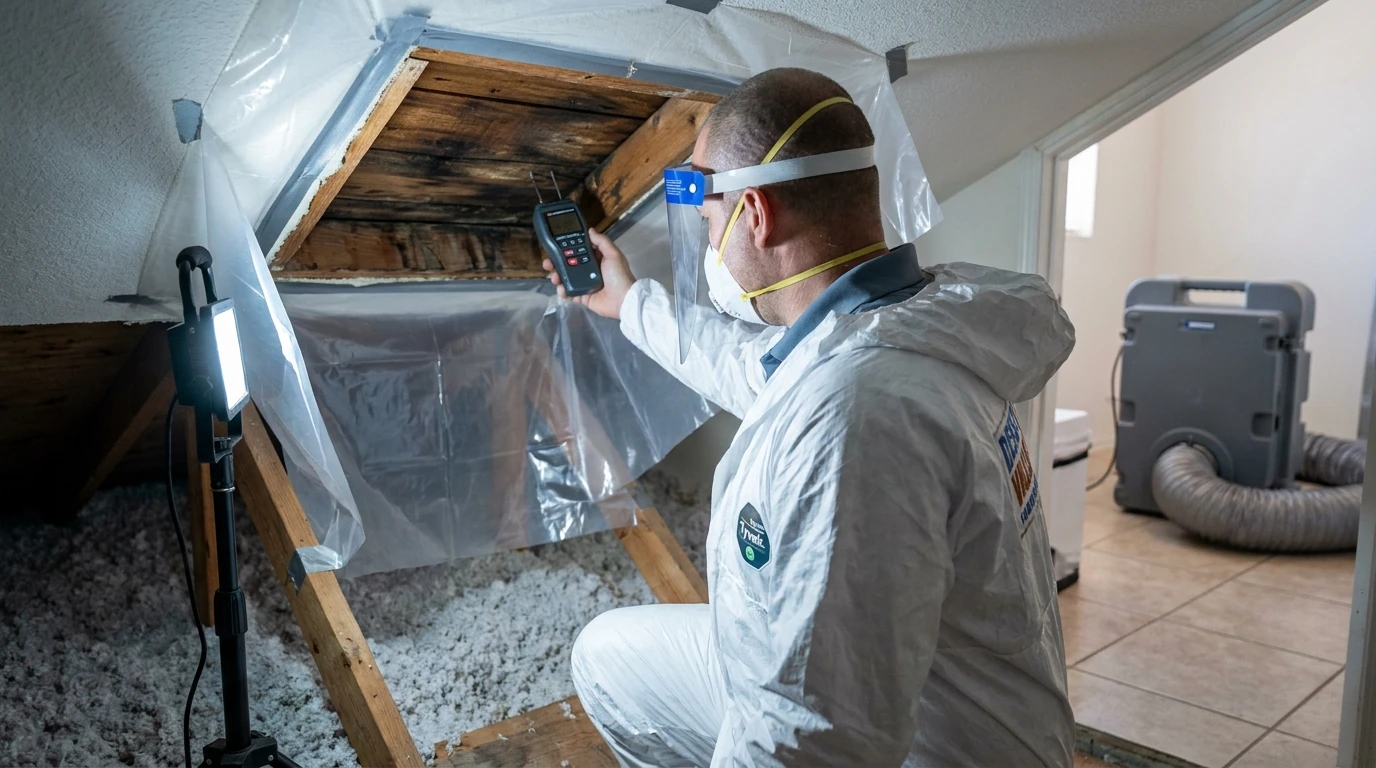
If you pulled down the attic hatch to check on your HVAC unit and found dark, speckled staining across the roof decking or rafters, you’re looking at exactly the kind of damage we see across Summerlin, Spring Valley, and older North Las Vegas neighborhoods every monsoon season. A lot of homeowners assume mold can’t happen here because Las Vegas sits in a desert. That assumption is wrong, and it’s the single most common reason attic mold gets ignored until it’s a bigger, more expensive job.
What Causes Attic Mold in a Desert Climate Like Las Vegas?
Attic mold in Clark County almost always traces back to a mechanical moisture source, not outdoor humidity. Mold needs a relative humidity above roughly 60% on a surface to establish, and attics here hit that locally around specific failure points even when the outside air is bone dry.
The usual suspects, in order of how often we find them:
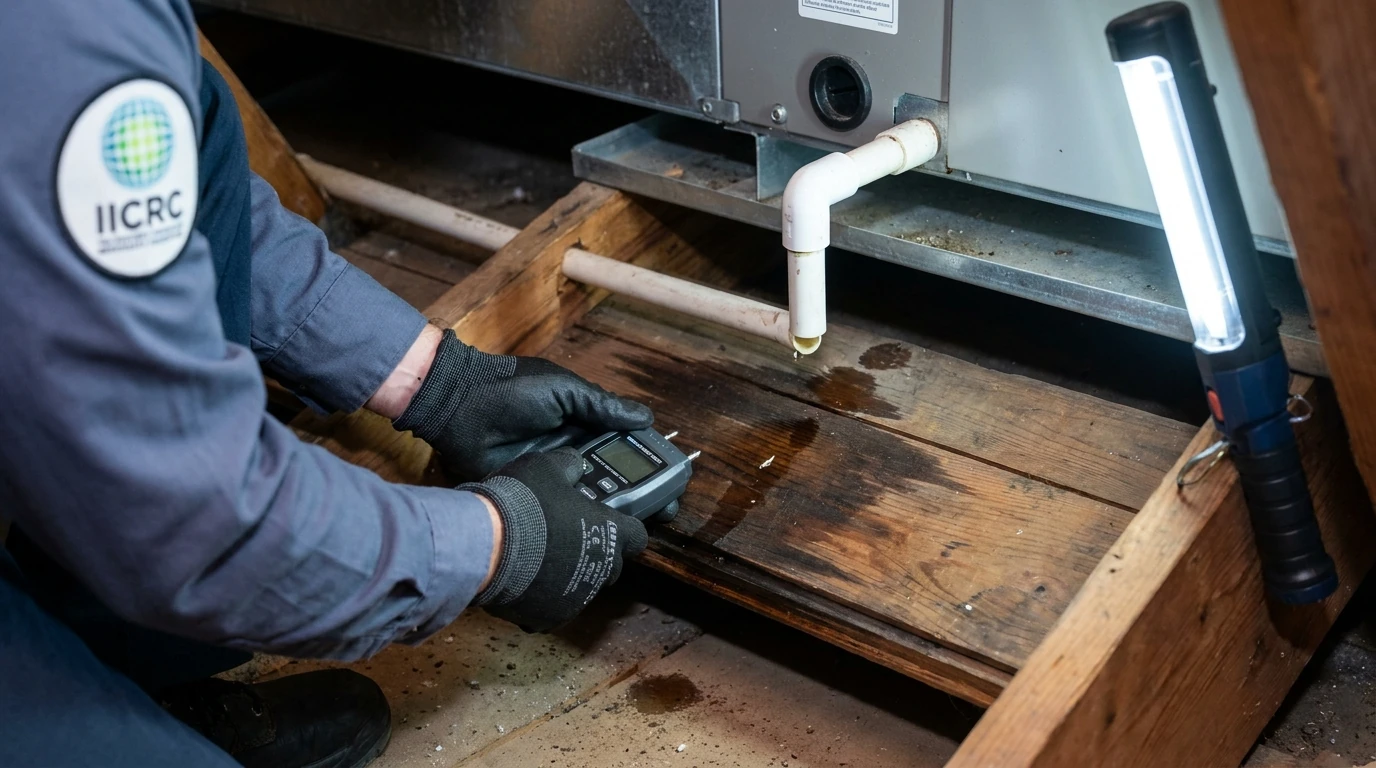
- A sweating or disconnected AC condensate line. Attic-mounted air handlers condense gallons of water a day in summer. If the drain line clogs, the insulation isn’t wrapped correctly, or the line simply pops loose, that water lands on the same wood and insulation month after month.
- A bathroom or kitchen exhaust fan venting into the attic instead of through the roof or wall. This is extremely common in homes built or renovated before code enforcement tightened up, and it dumps warm, moist bathroom air directly onto cold roof decking night after night.
- Roof leaks from monsoon season. July through September storms drive wind-blown rain under loose flashing, cracked tile, or aged underlayment. The leak might only run for twenty minutes during a storm, but the wet decking stays damp for days afterward in a sealed attic space.
- Poor attic ventilation. Blocked soffit vents or undersized ridge venting trap whatever moisture does get in, instead of letting it flush out.
The practical takeaway: a desert climate does not make a house mold-proof. It just means the water almost always has a mechanical or structural cause you can actually find and fix, rather than ambient humidity you can’t control.
What Are the Signs of Mold in Your Attic?
The clearest signs are a musty smell near the attic hatch, dark or black staining on roof decking and rafters, and noticeably higher summer cooling costs. Any one of these on its own is worth an inspection; two or more together usually means active growth.
Specific things to check for:
- Musty or earthy odor when you open the attic access, especially noticeable right after the AC has been running.
- Dark staining or fuzzy growth on the underside of the roof deck, concentrated around vent penetrations, the AC unit, or bathroom ductwork.
- Visible water staining or drip marks on insulation, especially directly below the attic AC unit or condensate line.
- Rusted nail heads or metal fasteners poking through the roof deck. Those rust first, long before you can see the mold itself.
- An AC system that seems to run longer than it used to without a clear reason, which often points to a condensate or duct problem feeding attic moisture at the same time.
If you’re already seeing visible growth on drywall or baseboards elsewhere in the house, not just the attic, it’s worth reading through our guide on signs of hidden mold and how to test for mold before deciding whether this is a spot-treatment or a full remediation.
How Much Does Attic Mold Remediation Cost in Las Vegas?
Most attic mold remediation jobs in the Las Vegas area run $1,500 to $5,500, with the final number driven by square footage affected, whether insulation needs full replacement, and how much repair the moisture source itself requires.
| Scenario | Typical Cost Range |
|---|---|
| Isolated spot (under 10 sq ft, surface mold only) | $600 to $1,500 |
| Moderate attic contamination (HVAC-area moisture, insulation removal) | $1,500 to $3,500 |
| Widespread contamination across roof decking | $3,500 to $6,500 |
| Roof leak repair or flashing replacement (separate line item) | $400 to $2,500 |
| AC condensate line repair or reroute | $200 to $800 |
| Post-remediation clearance testing | $300 to $600 |
These are typical industry figures for the region, not a quote. Every attic is different, and we walk every job with a moisture meter before writing a scope, not after. If you want more detail on how mold remediation pricing works across a whole property, not just an attic, we cover that in how much mold remediation costs in North Las Vegas.
Insurance coverage depends on the cause. A sudden roof leak from a monsoon storm is often covered as storm damage under a standard homeowners policy. Mold from a slow AC condensate leak that’s been dripping for months is usually treated as a maintenance issue and excluded. That distinction is worth nailing down with your adjuster before work starts, and it’s part of why documenting the moisture source matters as much as documenting the mold.
What Does Attic Mold Remediation Actually Involve?
Attic mold remediation follows the same core process as any interior mold job: find the moisture source, contain the space, remove contaminated material, and verify the air and surfaces are clear before closing it back up.
In practice that looks like:
- Inspection and moisture mapping. A technician checks the AC unit, condensate line, bath fan ducting, and roof penetrations with a moisture meter to find every active source, not just the obvious one.
- Containment. Poly sheeting seals the attic hatch and any return air pathways so spores don’t migrate into the living space while work is underway.
- Removal. Contaminated insulation gets bagged and removed. Affected roof decking and rafters are HEPA-vacuumed, and in heavier cases, media-blasted (dry ice or soda blasting) to strip mold from wood grain without soaking the structure further.
- Antimicrobial treatment. An EPA-registered antimicrobial is applied to treated wood surfaces following IICRC-informed remediation protocols.
- Moisture source repair. The condensate line gets rerouted or repaired, the bath fan gets re-ducted to the exterior, or the roof flashing gets replaced. This step is non-negotiable; skipping it is the number one reason attic mold comes back within a year.
- Clearance testing. A post-remediation air or surface sample confirms spore counts are back to a normal range before new insulation goes in.
If the source turns out to be storm-related roof damage rather than an HVAC issue, that repair typically falls under our storm damage restoration scope rather than the remediation line item itself, so the two often get scheduled together.
If you’re seeing staining, smelling must, or just had a roof inspection flag moisture after this season’s storms, the next step is a proper assessment, not a bleach bottle from the hardware store. Bleach kills surface spores on nonporous surfaces but doesn’t touch the roots growing into wood grain or insulation, and it does nothing about the moisture source that caused the problem in the first place.
Desert Valley Contracting works attics across Las Vegas, Henderson, and North Las Vegas with the same process: find the water first, then remove what grew because of it. If you want a written scope before anyone touches the attic, request a mold remediation assessment or see what we cover specifically in the Las Vegas service area.
About Desert Valley Contracting Inc
Desert Valley Contracting Inc is an IICRC-certified firm (AMRT mold remediation, WRT water, ASD structural drying) serving North Las Vegas, Las Vegas, Henderson, and surrounding Clark County since 2000, operating under license 0072652-B & B6. Their crews handle mold remediation, water damage restoration, storm damage restoration, fire damage restoration, and general contracting across the valley, with 24/7 emergency response for active water and storm losses.