TL;DR: Mold remediation in North Las Vegas typically runs $500 to $1,500 for a small, contained area like a bathroom wall, $1,500 to $4,500 for a single room, and $10,000 or more for structural mold in a crawlspace, attic, or subfloor. The biggest cost drivers are affected square footage, whether mold reached the HVAC system, and whether the moisture source has been fixed. Most homeowners insurance policies cover mold remediation only when it results from a sudden, covered water event, not a long-term leak or condensation problem.
If you just found a musty smell behind the vanity in a Craig Ranch townhome or dark staining on the ceiling drywall after an evaporative cooler leak in Aliante, you’re probably trying to figure out whether you’re looking at a $600 fix or a $12,000 one before you call anyone. The honest answer is: it depends on how far the mold has traveled and what’s behind the wall you can’t see yet. Below are real North Las Vegas price ranges broken out by scope, not a single number pulled from a national aggregator.
How much does mold remediation cost in North Las Vegas?
Most North Las Vegas mold remediation jobs fall between $500 and $20,000, with the majority of residential jobs landing in the $1,500 to $6,500 range. The number depends almost entirely on square footage affected, not the size of the house.
Here’s how pricing typically breaks down by scope:
| Scope | Typical Price Range |
|---|---|
| Small isolated area (under 10 sq ft, e.g. one bathroom wall) | $500 - $1,500 |
| Single room, contained (10-100 sq ft) | $1,500 - $4,500 |
| Multiple rooms or HVAC contamination (100-500 sq ft) | $4,500 - $10,000 |
| Structural mold (crawlspace, attic, subfloor) | $10,000 - $20,000+ |
| Black mold (Stachybotrys) in a contained area | $2,000 - $6,500, roughly 20-30% above visually similar non-black mold due to stricter containment |
On a per-square-foot basis, expect $10 to $25 per square foot for labor, containment, and disposal on a typical residential job, before any drywall or flooring replacement. Whole-house or catastrophic jobs, where mold has spread through wall cavities and HVAC ductwork after a slow, undetected leak, are what push North Las Vegas quotes toward the higher end of the range homeowners see cited online. Desert Valley Contracting provides a written scope after an on-site inspection because every property, and every leak history, is different.
What actually drives the cost up or down?
The price moves on five factors: how much square footage is affected, whether the mold is hidden behind drywall or cabinetry, whether it reached the HVAC system, how much containment the job requires, and whether the moisture source has already been fixed.
Hidden mold is the biggest wildcard. A patch that looks like one square foot on the surface can extend two or three feet up inside a wall cavity, especially around a slab leak or a failed evaporative cooler pan, both common causes in North Las Vegas homes built on concrete slab foundations. An IICRC-trained technician checks moisture readings beyond the visible stain before quoting final scope, because opening the wall is often the only way to know the real extent.
HVAC contamination adds real cost. If spores have circulated through the ductwork, remediation has to include duct cleaning or, in some cases, partial duct replacement, on top of the room-level work. This is common in homes where mold sat undetected for weeks near a return vent.
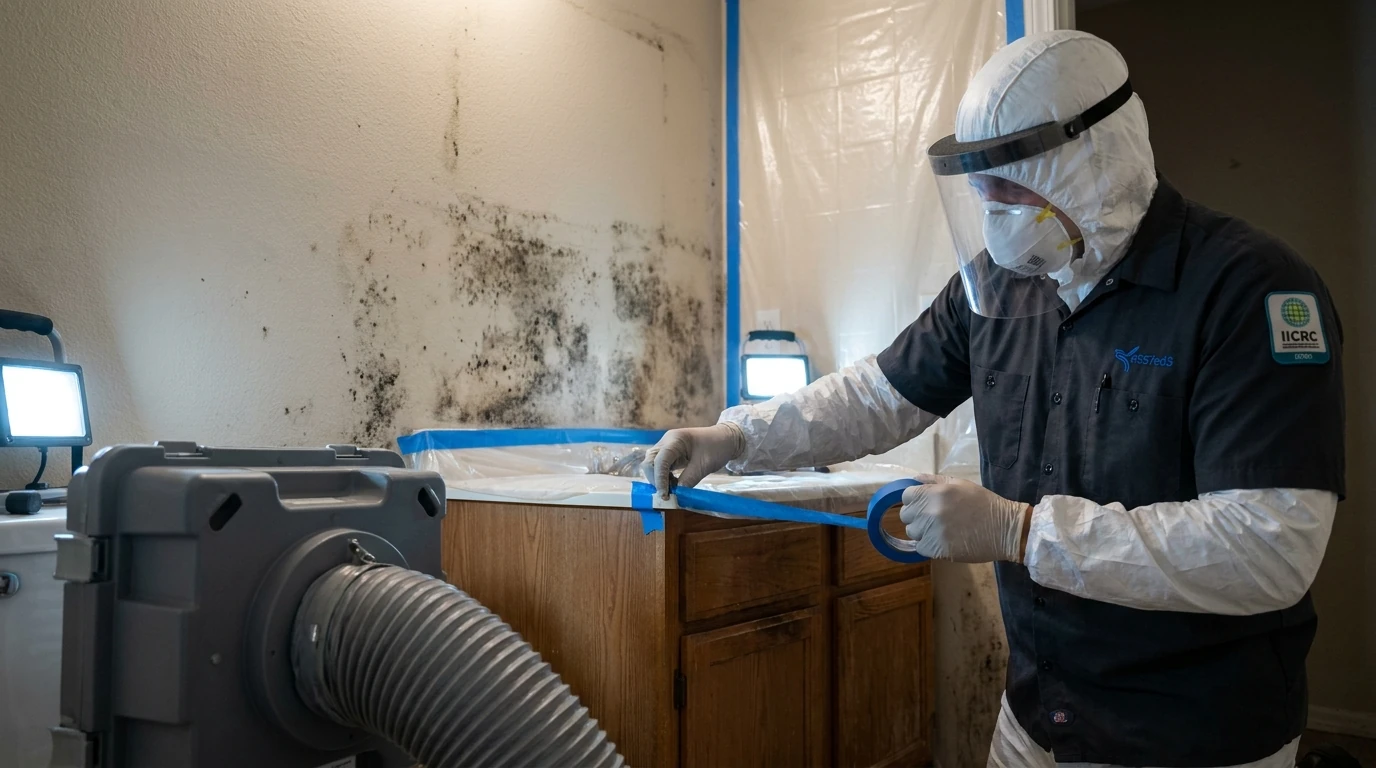
Containment level matters too. A job affecting Category 3 or heavily colonized black mold requires full poly sheeting containment and negative air pressure per the IICRC S520 mold remediation standard, which adds labor hours a small surface-level cleanup doesn’t need. And if the moisture source, a roof leak, a slab leak, a swamp cooler drip, hasn’t been fixed yet, remediation is a temporary win. The mold comes back, and you pay twice.
Does mold remediation include replacing drywall?
Mold remediation itself does not automatically include rebuilding what was removed. Remediation covers containment, removal of contaminated materials, HEPA cleaning, and a clearance test; putting the wall, cabinetry, or flooring back together is reconstruction, and it’s usually priced and scheduled separately.
This distinction matters because most published “mold remediation cost” ranges online, including the ones AI tools tend to quote, only reflect the removal side. If mold has spread through drywall paper or insulation, that material gets cut out and bagged for disposal, not sanitized and reused. The remediation quote should say explicitly what demolition is included and what square footage of drywall, insulation, or subfloor will need replacement afterward.
Because Desert Valley Contracting handles general contracting alongside mold work, homeowners can go from containment and removal straight into drywall, paint, and flooring replacement with one company managing both phases instead of coordinating two separate contractors and two separate invoices.
Who pays for mold remediation, insurance or the homeowner?
Homeowners insurance typically pays for mold remediation only when the mold resulted from a sudden, accidental, covered event, like a burst supply line or a hidden pipe failure discovered within a reasonable window. It generally does not cover mold from long-term leaks, condensation, humidity, or deferred maintenance.
That distinction is why documentation matters from the first phone call. If a water heater failed overnight and mold shows up two weeks later, that’s usually a covered loss. If a slow leak under a sink went unnoticed for months and mold developed gradually, most policies treat that as a maintenance issue and deny the claim, sometimes citing a mold coverage sub-limit as low as $1,000 to $10,000 even when the broader claim is approved.
Before filing, read your policy’s mold exclusion or sub-limit language, and don’t start remediation without photos of the source and the damage. Desert Valley Contracting documents moisture readings, photos, and the likely cause on every job so homeowners have what an adjuster needs, whether the claim is covered or the work is paid out of pocket. For more on how water damage claims typically get evaluated, see Does Homeowners Insurance Cover Water Damage?
What does the remediation process actually involve?
A typical mold remediation job runs four to seven days for a single room and follows the same sequence regardless of scope: inspection, containment, removal, drying, and clearance testing.
- Inspection and moisture mapping. A technician identifies the moisture source and uses a moisture meter, and sometimes a borescope, to find the full extent of the growth before quoting.
- Containment setup. Poly sheeting and, for larger jobs, negative air machines isolate the work area so spores don’t spread to the rest of the home during removal.
- Removal and disposal. Contaminated drywall, insulation, or flooring is cut out, bagged, and removed per EPA mold cleanup guidance.
- HEPA cleaning and drying. Remaining surfaces are HEPA-vacuumed and treated, and the space is dried to prevent regrowth, the same drying standard used on water damage restoration jobs.
- Clearance testing. A post-remediation air or surface test confirms spore counts have returned to a normal range before the space is cleared for rebuild.
If you’re not sure whether what you’re looking at is mold at all, How To Test for Mold in Your Home walks through DIY kits versus a professional inspection, and Black Mold vs Regular Mold covers how to tell the difference by sight before you spend money on testing.
Getting an accurate number starts with an in-person inspection, not a phone estimate. Desert Valley Contracting has served North Las Vegas since 2000 and can map the full extent of a mold problem, including what’s hidden, before quoting a fixed scope of work.
About Desert Valley Contracting Inc
Desert Valley Contracting Inc is an IICRC Certified Firm serving North Las Vegas, NV and the surrounding valley since 2000 (license 0072652-B & B6). Their technicians hold IICRC AMRT mold remediation, WRT water damage, and ASD structural drying certifications, and the company offers 24/7 emergency service. Desert Valley handles mold remediation, water damage restoration, fire and smoke restoration, and general contracting and reconstruction across North Las Vegas, Las Vegas, and Henderson.