Industrial Restoration in North Las Vegas
24/7 industrial restoration in North Las Vegas and surrounding areas. IICRC-certified, insurance billing accepted. Call (702) 633-5033.
Industrial water damage or fire damage shutting down a warehouse, plant, or distribution center? Call now for emergency service. We answer 24/7, because a burst fire suppression line or a scorched electrical panel on a 50,000 square foot floor doesn’t wait for business hours, and every hour a facility stays offline compounds the loss.
Industrial losses behave differently than a residential flood or a kitchen fire. The square footage is bigger, the ceiling heights change how smoke and moisture settle, and the building usually can’t just close for three weeks while drying happens. Tilt-up concrete and metal building systems, common throughout North Las Vegas’s industrial corridors near the I-15 and I-215, hold moisture differently than wood-frame construction, and roll-up doors, dock levelers, and mezzanine storage all complicate extraction and containment. A manufacturing facility with process equipment, raw material inventory, or climate-sensitive product adds another layer: the restoration has to work around what the business can’t afford to lose.
What industrial restoration actually involves
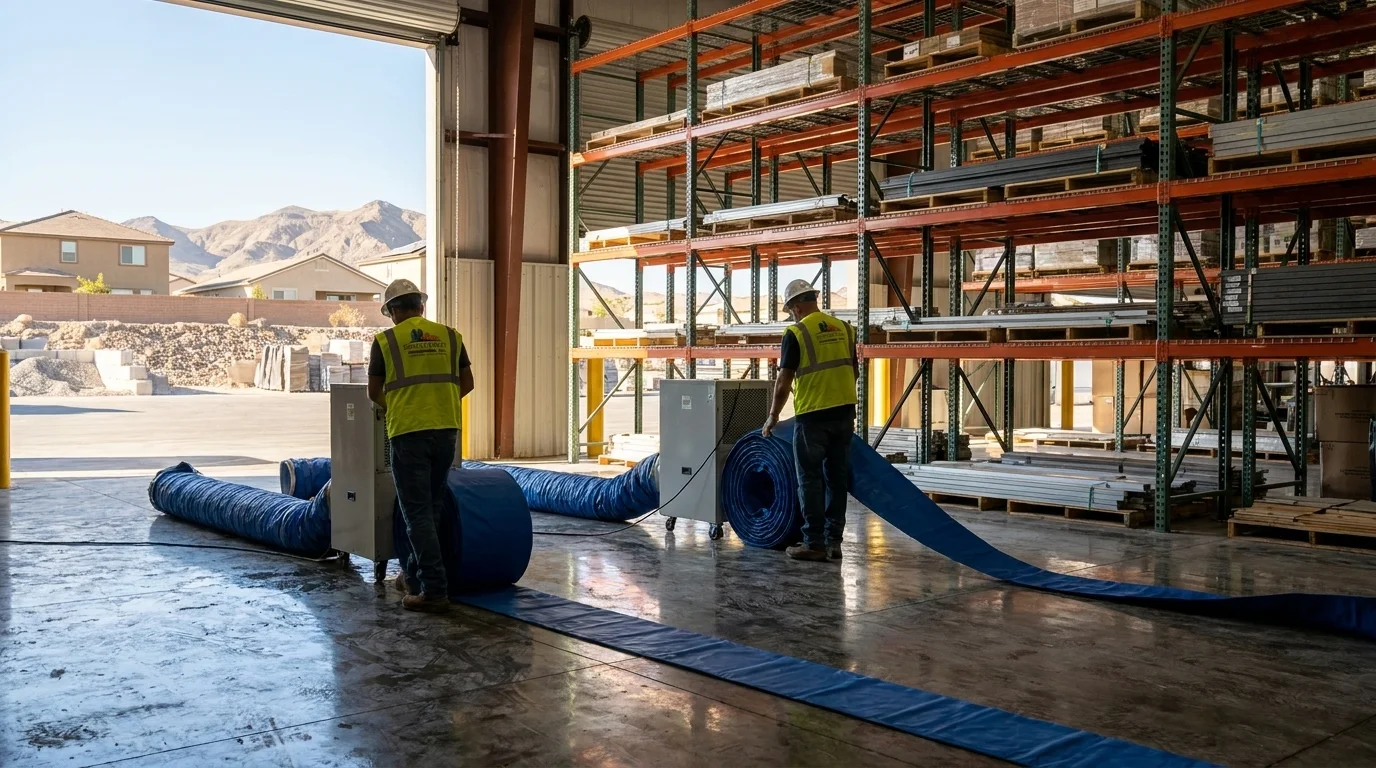
Industrial restoration covers water intrusion from roof failures, sprinkler discharge, and plumbing breaks; fire and smoke damage to structure, racking, and equipment; and the large-scale drying and cleaning that follows. The work typically involves high-capacity extraction units, desiccant dehumidification sized for open warehouse volumes (standard residential dehumidifiers can’t keep up with a 30-foot ceiling), and moisture mapping across concrete slabs and tilt-up panels that can hold water for weeks if undetected. On the fire side, soot characterization determines whether synthetic residues from plastics and packaging, or protein-based residue from combusted materials, are driving the cleanup method. Timelines run longer than residential jobs, often one to several weeks depending on affected square footage, inventory loss, and whether production can continue in unaffected zones.
Our process
- Site assessment and safety lockout. Before any crew enters, we identify electrical hazards, confined spaces, compromised racking, and any area that needs to be locked out under OSHA guidelines before mitigation starts.
- Large-scale extraction or smoke and soot mitigation. Industrial-grade extraction equipment removes standing water from slabs and sub-grade areas; for fire losses, thermal fogging and HEPA air scrubbing address airborne soot before it settles further into HVAC systems and inventory.
- Moisture mapping and zone containment. We map moisture across the full affected footprint, then contain and isolate the wet or smoke-damaged zones so unaffected areas of the plant or warehouse can often stay operational.
- Staged structural drying and monitoring. Desiccant dehumidification and directed air movement run on a documented monitoring schedule, tracking moisture content in concrete, framing, and any affected racking or shelving until readings hit dry standard.
- Documentation and reconciliation. Every stage gets photographed and logged for the facility’s insurance carrier and, where relevant, for business interruption claims tied to downtime.
What separates a good industrial restoration response from a bad one
The most common mistake on large losses is treating a warehouse like an oversized house: undersized drying equipment, no zone containment strategy, and moisture readings taken only at the surface while subfloor or wall cavity moisture goes unchecked. Concrete slabs are deceptive. They can read dry on a surface meter while moisture is still migrating upward from below, which is why structural drying needs to follow a documented protocol rather than a visual check. On fire losses, a weak response skips soot characterization entirely and uses one cleaning method on every surface, which either under-cleans porous materials or damages sensitive equipment with the wrong chemical approach. Insurance adjusters on industrial claims are looking for daily moisture logs, clear before-and-after documentation by zone, and a scope of work that separates mitigation from any rebuild. Facilities that can show a clean paper trail tend to see faster claim resolution.
What does industrial restoration cost?
Industrial restoration costs vary more than residential work because square footage, affected systems, and inventory loss all move the number. Typical industry figures below are a starting reference, not a quote. Every loss is different, and Desert Valley Restoration provides a written scope of work before any work begins. Most commercial property policies cover sudden water and fire losses, including mitigation and structural drying, though business interruption and inventory loss often fall under separate policy provisions worth reviewing with your carrier.
| Scenario | Typical range |
|---|---|
| Localized roof leak, small storage area | $3,000 - $9,000 |
| Sprinkler discharge, single warehouse zone | $8,000 - $25,000 |
| Large-footprint water extraction and drying (10,000+ sq ft) | $20,000 - $75,000 |
| Fire and smoke mitigation, single production line | $15,000 - $50,000 |
| Full facility smoke remediation with HVAC cleaning | $40,000 - $150,000+ |
Seasonal & regional considerations
North Las Vegas’s summer monsoon season brings sudden, heavy rainfall that older or poorly maintained flat and low-slope industrial roofs aren’t always built to shed quickly, which is when roof leaks and interior flooding spike. The rest of the year’s low humidity actually helps drying move faster once extraction is complete, but it also means any moisture trapped inside tilt-up panels or beneath flooring can go unnoticed longer because surfaces dry visually while the structure stays wet underneath.
Service area
Desert Valley Restoration responds to industrial and commercial properties throughout North Las Vegas and the surrounding Las Vegas Valley, including the warehouse and manufacturing corridors near the I-15 and I-215 interchanges.
If water, fire, or smoke has shut down any part of your facility, get a written scope of work started now. Call (702) 633-5033 to schedule an industrial restoration assessment.
Frequently Asked Questions
Does commercial property insurance cover industrial water or fire damage restoration?
Can part of our warehouse keep operating while the affected zone is being restored?
How is industrial structural drying different from drying out a house?
What's the difference in cleanup between synthetic soot and protein-based soot in an industrial fire?
What should facility management do in the first few hours after discovering water or fire damage?
Looking for the best industrial restoration company in North Las Vegas?
Desert Valley Restoration provides licensed and insured industrial restoration in North Las Vegas, NV and the surrounding area, and has served local property owners since 2000. Customers rate us 4.3 out of 5 stars across 95 Google reviews. We answer calls 24/7 — call (702) 633-5033 for immediate help.
Need Industrial Restoration now?
We respond 24/7 across North Las Vegas and surrounding NV cities.
Related Coverage
- Our Restoration Services
- Contact Desert Valley Restoration
- Restoration Services in Blue Diamond
- Restoration Services in Boulder City
- Restoration Services in Enterprise
- Restoration Services in Henderson
- Restoration Services in Indian Springs
- Restoration Services in Las Vegas
- Restoration Services in Moapa Town
- Restoration Services in Moapa Valley
- Restoration Services in Mount Charleston
- Restoration Services in Nelson
- Restoration Services in Pahrump
- Restoration Services in Paradise