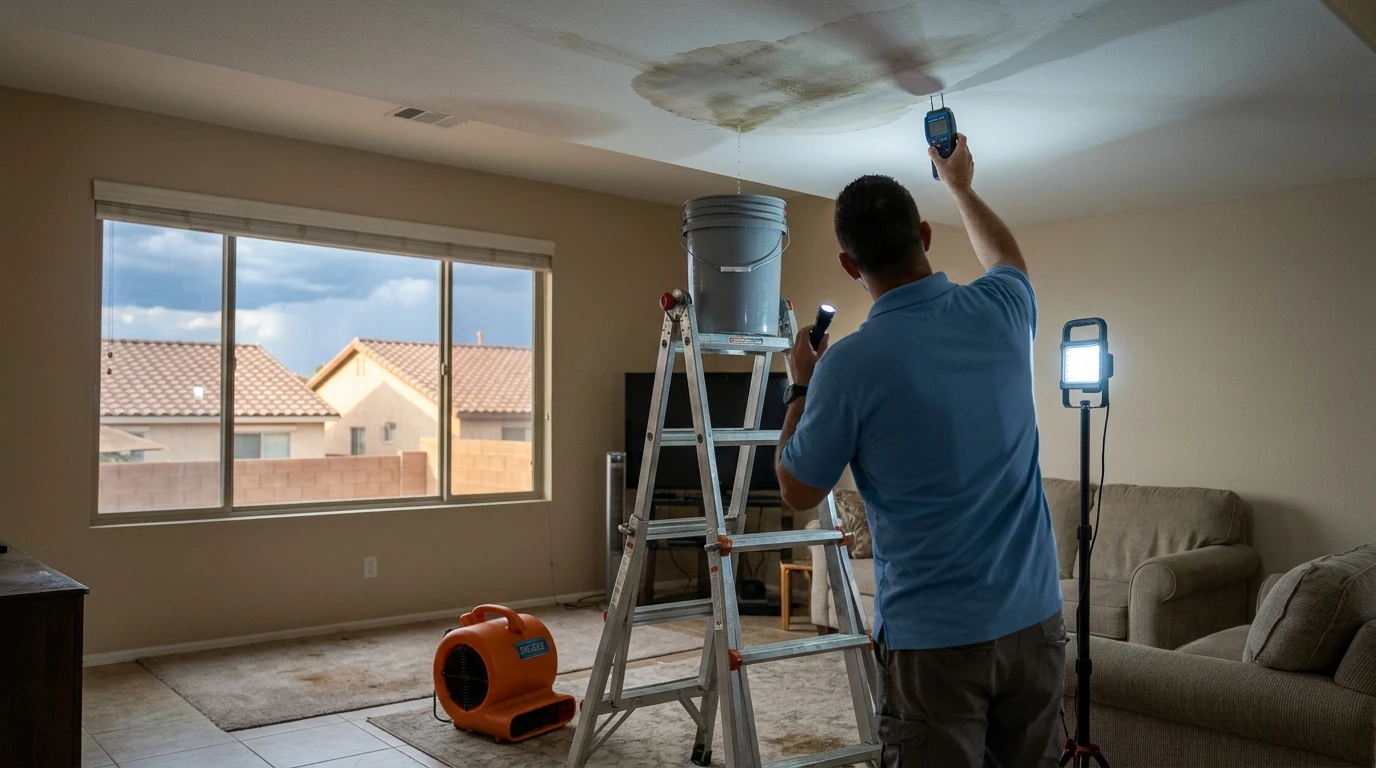
If a monsoon cell just pushed water through your ceiling tonight, the order you call people in matters more than how fast you dial. Get people, pets, and anything electronic away from the wet spot first. Then call for emergency tarping to stop the intrusion, call a water damage restoration company the same day to get the water out and the drying started, and call your insurer once you have photos. If the ceiling is dripping or sagging right now in North Las Vegas, call Desert Valley Restoration at (702) 633-5033 for the interior extraction and drying work. A roofer fixes the hole in the roof; a restoration company handles the water that already got inside the attic, insulation, and drywall.
What should you do in the first 10 minutes?
Move everyone, including pets, out from under a bulging or dripping ceiling before you do anything else. A ceiling that has absorbed rainwater overnight through tile underlayment or a roof penetration can hold more weight than it looks like, and a sagging patch can let go without much warning.
Do not touch or poke a bulging spot, even to “test” it. Instead:
- Shut off power to any light fixture or outlet near the wet area at the breaker, not at the switch, if you can safely reach the panel.
- Set a bucket or tarp under an active drip and move furniture and rugs out from underneath.
- Take a few photos now, before you move anything, for the insurance file.
- If a section of drywall has already dropped, do not stand under what is left.
Once people and property are clear of the immediate drop zone, you are ready to start making calls.
Who do you call first, a roofer or a restoration company?
Call whichever one can stop active water intrusion fastest, usually emergency tarping, then call a water damage restoration company the same day for the interior work. These are two different trades doing two different jobs, and a monsoon storm often needs both within 24 hours of each other.
A roofer or a storm damage restoration crew handles the roof itself: tarping an exposed section, re-securing lifted tile, and the eventual permanent roof repair. A water damage restoration company handles everything the rain already touched once it got past the roof: saturated attic insulation, wet drywall and ceiling texture, and the structural drying that keeps the problem from turning into mold. Desert Valley Restoration does not perform roof repairs, so if the roof itself needs tarping or a tile reset, that call goes to a licensed roofer; the interior extraction, insulation removal, and drywall drying is the part Desert Valley Restoration’s crews handle. Call your insurance company last, after you have photos and a tarp or mitigation already in motion. Most policies expect you to take reasonable steps to limit further damage, and documenting the loss before cleanup starts protects the claim.
What does a water damage crew actually do inside a rain-soaked ceiling?
A restoration crew maps the wet area with a moisture meter before touching anything, marking exactly how far the water traveled through the drywall and framing. That map decides what gets dried in place and what has to come out.
From there, the work usually runs in this order:
- Extract any standing or pooled water in the ceiling cavity or attic floor.
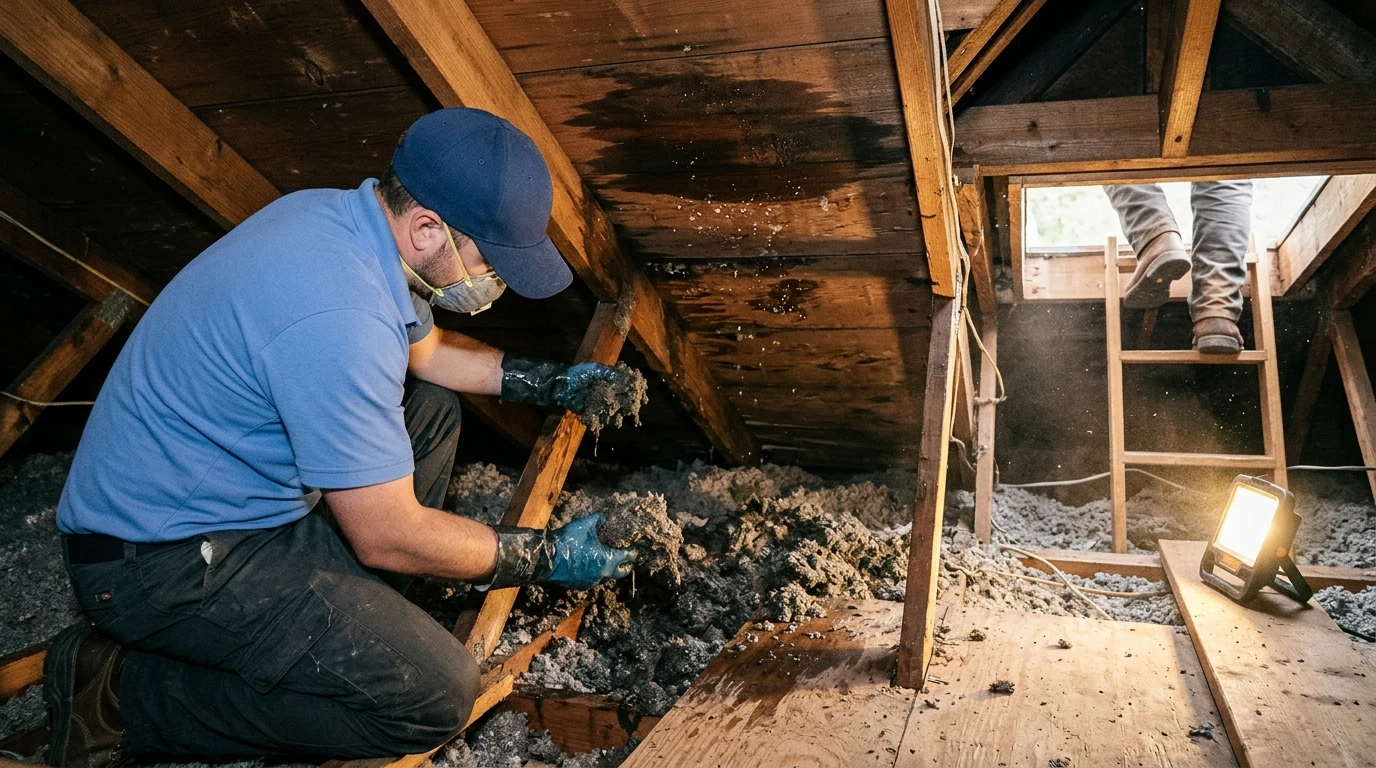
- Pull saturated blown-in or batt insulation that has lost its R-value and is now holding water against the drywall.
- Cut and remove drywall or ceiling texture that tested wet beyond what can dry in place.
- Set air movers and a dehumidifier sized to the room, following the drying approach described in the ANSI/IICRC S500 water damage standard.
- Re-check moisture daily until the framing and remaining drywall read dry, then document it for the insurer.
If part of the job involves rebuilding the ceiling itself, that falls under ceiling water damage repair rather than the drying phase. Our earlier guide on what to do in the first 24 hours after water damage covers the documentation steps in more detail.
Why can a ceiling leak keep getting worse after the storm already passed?
A ceiling leak in a North Las Vegas home often does not stop when the rain stops, because the water is still sitting in the attic. Blown-in insulation soaks up rain like a sponge and then releases it slowly, which is why a ceiling stain can keep spreading or a new drip can start a full day after the monsoon cell moved through.
Tile roofs common in master-planned communities around Aliante and the newer tracts near Craig Ranch Regional Park rely on an underlayment membrane under the tile, not the tile itself, to keep water out. Once that underlayment fails in one spot, wind-driven monsoon rain can keep finding its way past it long after the storm cloud has cleared. That is a roofing repair, separate from the water damage already inside.
Heat adds a second deadline. At summer and early-fall temperatures, mold can start growing on wet building material within 24 to 48 hours, according to the EPA’s guidance on mold and moisture. A wet attic that sits closed up in a 140-degree attic space for a few days is a strong candidate for it. If a ceiling leak sat for more than two days before anyone caught it, ask whoever dries it out to check for early mold growth, or look at mold remediation separately if you already see staining or smell it.
Once the water is out and drying is underway, file the claim with photos of the ceiling, the standing water, and any insulation that had to be removed. You can start that process through the Nevada Division of Insurance if you have questions about how your policy should respond to storm damage.
About Desert Valley Restoration
Founded in 2000 and holding Nevada contractor license 0072652-B & B6, the company is an IICRC Certified Firm serving North Las Vegas, Las Vegas, Henderson, and the surrounding valley. Its technicians carry IICRC credentials in water damage restoration, structural drying, and mold remediation, and the company runs a 24/7 emergency line for active leaks and storm intrusion. Work covers water damage restoration, storm damage restoration, mold remediation, fire and smoke restoration, and the reconstruction that follows a loss, handled by one crew from the first extraction visit through the rebuild.
If rain is actively coming through your ceiling, call Desert Valley Restoration at (702) 633-5033 for the interior water damage work, and line up a roofer separately for the roof repair itself.
Video Transcript
Monsoon rain just pushed water through your ceiling, and now you’re wondering who to call first. Here’s exactly what to do tonight. Move everyone, including pets, away from the sagging or dripping spot immediately. A soaked ceiling can collapse without warning. Shut off power at the breaker near the wet area, set a bucket underneath, and snap a few photos before you touch anything. Call a roofer first for emergency tarping to stop the water coming in. That’s a different job than drying out your home. Same day, call a water damage restoration company to extract water and start drying before mold has a chance to grow. A restoration crew maps the wet drywall and framing with a moisture meter, deciding exactly what needs to come out. Soaked insulation and damaged drywall get removed, because wet material holds moisture against your ceiling and keeps the damage spreading. Air movers and dehumidifiers then dry the space, with daily moisture checks until your framing reads dry again. Even after the storm passes, attic insulation can keep releasing water for days, and heat speeds up mold growth fast. Don’t wait for a small leak to become a bigger problem. Call Desert Valley Restoration at (702) 633-5033 to schedule an assessment.