
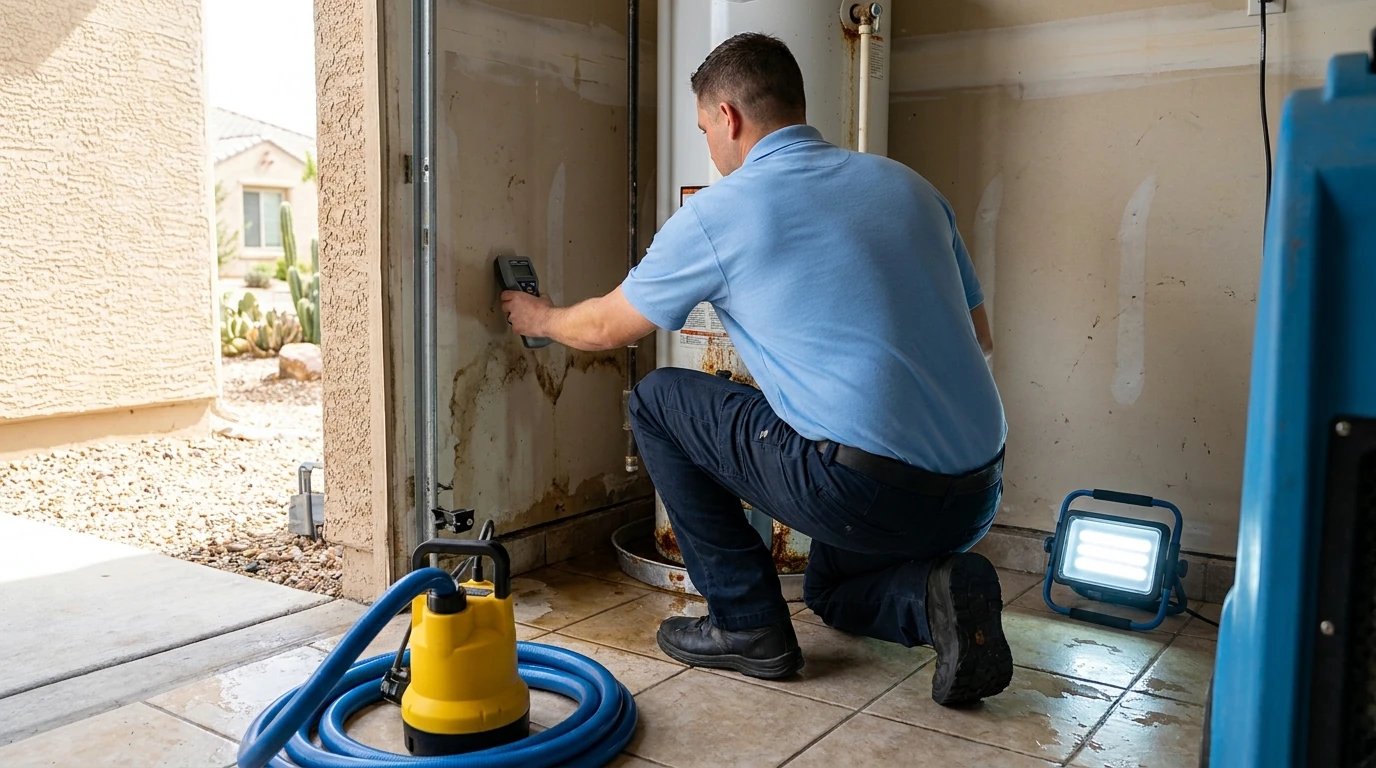
If your water heater just split open in the garage or a hallway closet and water is spreading across the tile, do two things in the next five minutes. Shut off the water supply valve on top of the tank, then kill the gas valve or the breaker that powers it. After that, make two calls: a licensed plumber to repair or replace the heater itself, and a restoration company such as Desert Valley Restoration at (702) 633-5033 to extract the standing water and start drying the walls, baseboards and slab before mold gets a foothold. The company is an IICRC Certified Firm that runs crews around the clock and holds an active Nevada contractor license (0072652-B & B6). One call fixes the appliance. The other saves the structure around it.
Why does a water heater flood need two different calls?
A plumber and a restoration crew do two different jobs, and calling only one leaves half the problem unsolved. The plumber’s job stops at the tank: diagnosing the failure, shutting down the line permanently, and installing a new unit or repairing a fitting. Everything the water touched after it left the tank, carpet pad, drywall, baseboards, and the concrete slab underneath most North Las Vegas homes, is a separate job that a plumber isn’t equipped or insured to handle.
Hard water across the Las Vegas valley is also part of why this happens so often here. Mineral buildup inside a tank water heater accelerates corrosion and sediment accumulation, and tanks in this market frequently fail years before their rated lifespan, usually through a cracked tank shell or a burst fitting near the bottom. Because that failure point often starts as a slow weep before the tank fully lets go, water can sit against drywall and baseboards for hours before anyone notices a puddle on the garage floor.
What should I do before either company arrives?
The five minutes right after you spot the leak matter more than the hour after that. Shut off the water and the power or gas first, since a wet/dry vac or standing water near an energized electric water heater is a shock hazard.
After the utilities are off:
- Move boxes, furniture and anything else off the wet floor
- Open the closet door or garage access for airflow
- Photograph the standing water, the tank’s data plate, and any visible damage before anything gets touched or thrown out
- Skip DIY fans and space heaters aimed at wet drywall; trapped moisture behind the wall needs equipment, not a box fan
Those photos matter twice: the plumber needs the data plate to order the right replacement, and the insurer will ask for them if you file a claim.
What happens when a restoration crew comes for a water heater flood?
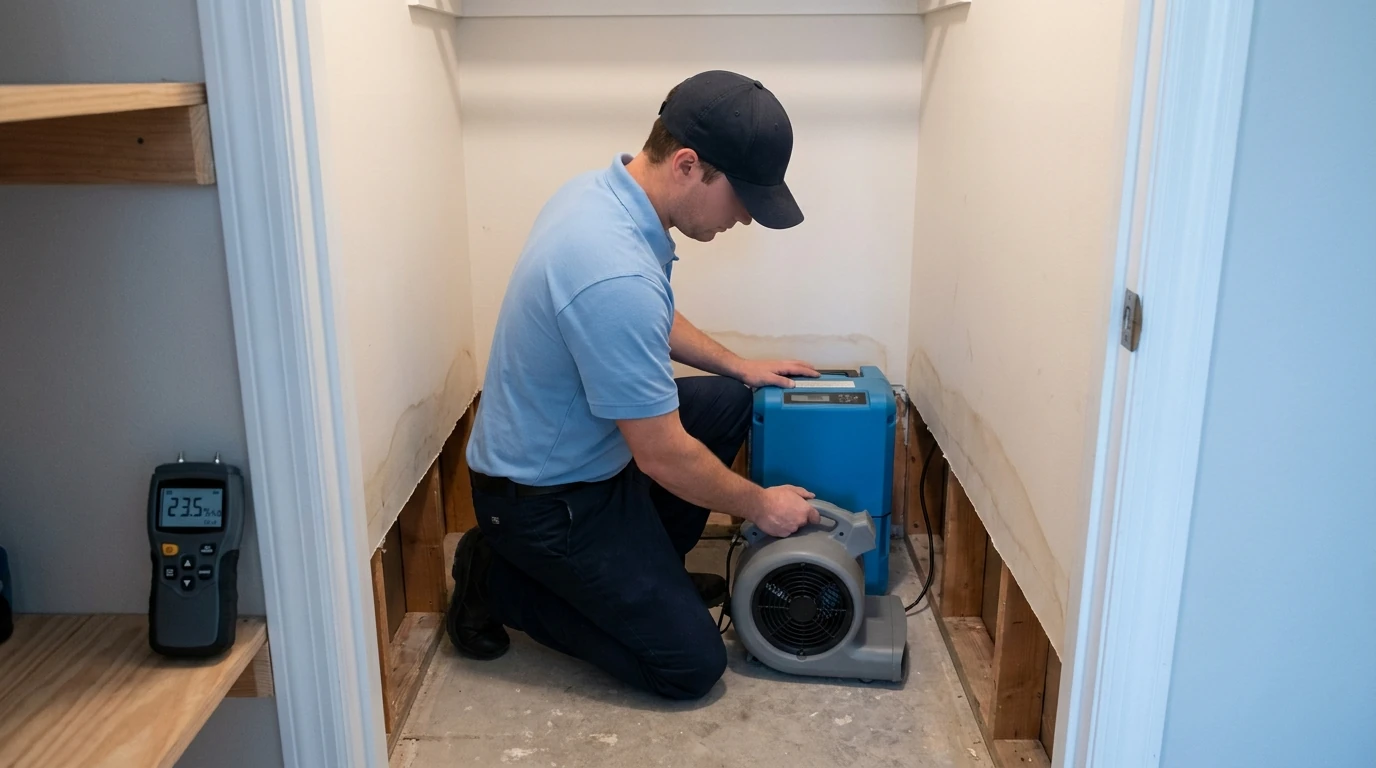
A restoration crew extracts the standing water first, then uses a moisture meter to map how far it traveled under flooring and inside the wall cavity before cutting back any drywall. Most of that mapping happens in the first hour on site, because the extent of the wet area, not just the visible puddle, determines how much material has to come out.
From there the job typically follows the same sequence: extraction, moisture mapping, controlled demolition of only the baseboard and the lowest few inches of drywall that tested wet, then air movers and a dehumidifier set to hit drying targets under the ANSI/IICRC S500 standard. A single garage or closet flood usually dries in three to five days with daily moisture checks, assuming the water was caught within a day. The reason the timeline matters: the EPA notes mold can begin growing on wet materials within 24 to 48 hours, so the gap between the flood and the first extraction call is the single biggest factor in whether this stays a drying job or turns into a mold remediation job too.
For a full walkthrough of what to document and prioritize in that first day, see what to do in the first 24 hours after water damage.
Will homeowners insurance pay for a water heater flood in North Las Vegas?
Most standard homeowners policies cover sudden, accidental water damage, which is exactly what a water heater tank failure usually is. The Insurance Information Institute notes that standard policies typically cover sudden and accidental water discharge from a plumbing system or appliance, which is the category a burst tank usually falls under.
Two things it usually does not cover without a closer look at your policy: the cost of the new water heater itself, since many insurers treat appliance failure as a maintenance issue rather than a covered peril, and any damage traced back to a slow, long-term leak instead of a sudden rupture. Document the failure, keep the plumber’s invoice and the restoration company’s drying report, and start the claim promptly, since most policies expect homeowners to mitigate damage right away rather than wait. For more on what’s typically covered, see does homeowners insurance cover water damage.
Getting the plumber and the restoration call out quickly after a water heater fails is what keeps this a one-day cleanup instead of a torn-out wall and a mold problem two weeks later. If the water has already been sitting for more than a day, treat moisture mapping and drying as the priority before anything gets patched or painted over.
Frequently Asked Questions
Who should I call first for a flooded water heater in North Las Vegas? Call a licensed plumber to stop the leak at its source, then call a restoration company such as Desert Valley Restoration at (702) 633-5033 to extract the standing water and start drying before mold has a chance to take hold. Both calls can happen within minutes of each other; neither one replaces the other.
Does a restoration company replace the water heater itself? No. Restoration crews handle the water damage left behind, not the plumbing repair. A licensed plumber repairs or replaces the tank, while the restoration side extracts the water and dries out the drywall, baseboards and flooring it touched.
How fast does mold start after a water heater floods a closet or garage? Mold can begin growing on wet drywall, baseboard and carpet pad within 24 to 48 hours, according to the EPA. That window is why extraction and drying should start the same day the leak is found, not after the replacement heater is installed.
Will my insurance pay to replace the water heater, or just the water damage cleanup? Most policies lean toward covering the sudden water damage the failure caused, not the appliance itself, since a worn-out tank is often treated as a maintenance issue. Check your specific policy language and keep both the plumber’s invoice and the drying documentation when you file.
Need help now? Call Desert Valley Restoration at (702) 633-5033.