TL;DR: In Boulder City, NV, general contracting covers everything from post-disaster reconstruction after water, fire, or storm damage to planned kitchen, bath, and structural renovations. A licensed contractor coordinates permits, subcontractors, and materials so you get a finished, code-compliant space without managing the job yourself. Desert Valley Contracting Inc holds Nevada license 0072652-B & B6 and has served the greater Las Vegas area since 2000.
If you own a home or commercial property in Boulder City and you’re staring at a gutted room, a fire-damaged wall, or a bathroom that hasn’t been touched since 1985, you’re facing the same question most property owners face: do I hire a handyman, a specialty contractor, or a licensed general contractor? The answer depends on scope. For anything that touches structure, electrical, plumbing, or requires a permit in Clark County, you need a licensed GC who can pull the permits, coordinate the trades, and stand behind the finished work.
What Does a General Contractor Actually Do?
A general contractor manages the full construction process on your behalf: permitting, scheduling, subcontractor coordination, materials procurement, inspections, and final punch-list. You hire one point of contact instead of separately managing a framer, a drywall crew, a painter, a tile setter, and an electrician.
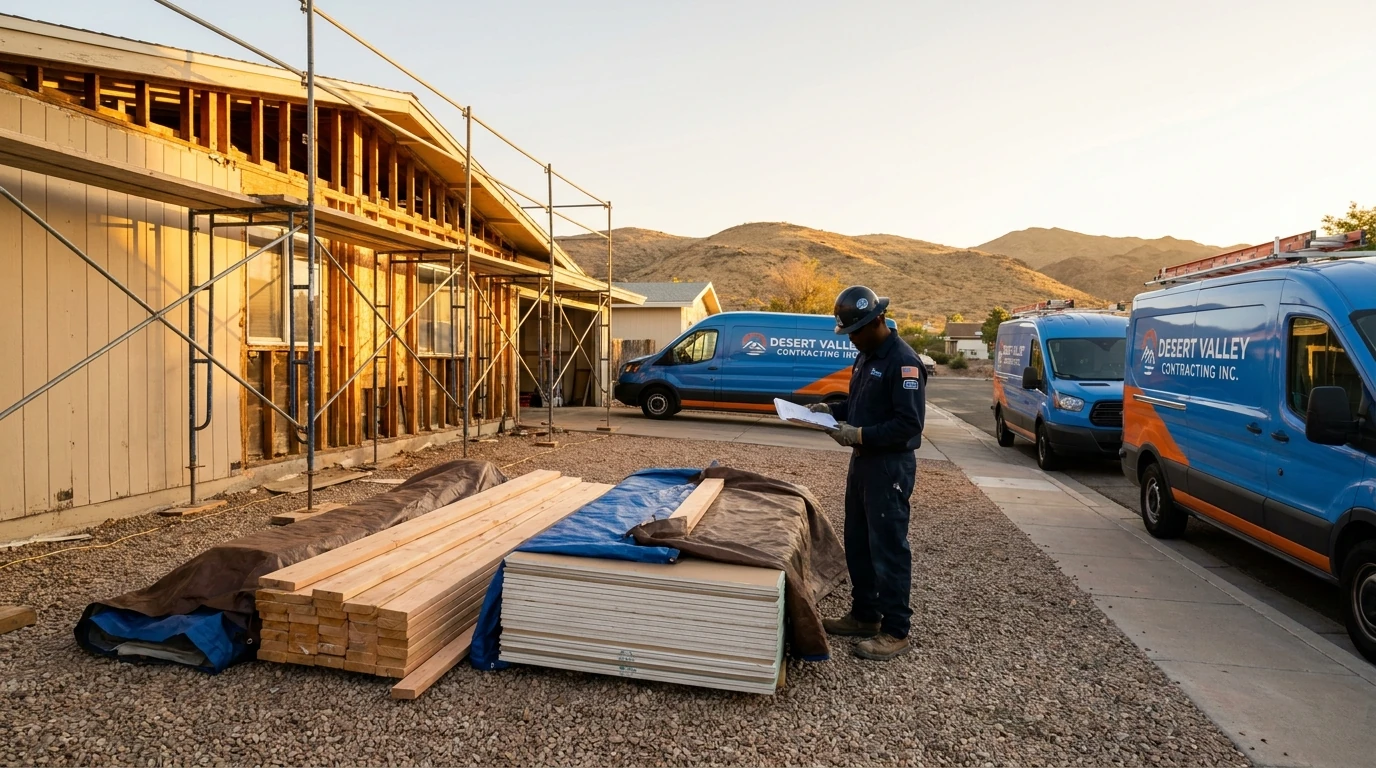
On a reconstruction job, the GC typically steps in after mitigation is complete. If Desert Valley Contracting already handled your water extraction or fire cleanup, the same team can carry the project through drywall, flooring, cabinetry, and paint. That continuity matters: the crew already knows what was removed, what the insurance adjuster documented, and what the scope of work requires. There is no handoff gap where something falls through.
On a planned renovation, the GC starts earlier: reviewing your design intent, pulling permits at the Clark County Building Department, and building a realistic schedule before a single tool touches the wall.
What Projects Require a Licensed Contractor in Nevada?
Nevada requires a licensed contractor for most projects valued over $1,000 that involve structural work, electrical, plumbing, or mechanical systems. Clark County and Boulder City have their own permit requirements layered on top of state law.
Projects that typically require a permit and a licensed GC in Boulder City:
- Structural wall removal or addition
- Roof replacement or repair beyond minor patching
- Electrical panel upgrades or new circuit runs
- Plumbing reroutes (common in post-flood reconstruction)
- HVAC system replacement
- Full kitchen or bathroom remodels that touch plumbing or electrical
- Room additions or garage conversions
- Post-fire or post-flood reconstruction of any structural component
Working without a permit on permitted-scope work creates real problems: unpermitted work can void your homeowners insurance coverage, complicate a future sale, and require costly demolition and redo if discovered during inspection. The Nevada State Contractors Board maintains a license lookup tool if you want to verify any contractor’s standing before signing.
How Does Reconstruction After Damage Differ From a Standard Remodel?
Post-disaster reconstruction and planned renovation share the same trades and materials, but they differ in three important ways: insurance documentation, scope definition, and timeline pressure.
Insurance documentation. On a reconstruction job, the scope of work has to match what the insurance adjuster approved. Every line item in the estimate needs to correspond to documented damage. A contractor who has worked the insurance process before knows how to write a scope that protects your claim and avoids supplement disputes later. Desert Valley Contracting handles this documentation as part of the project, so you are not trying to reconcile an adjuster’s estimate with a contractor’s bid on your own.
Scope definition. On a remodel, you choose what changes. On a reconstruction, the damage defines the minimum scope, and you decide whether to upgrade materials or layouts while the walls are already open. That is actually an opportunity: if your kitchen flooring is being replaced because of a pipe leak, it costs far less to upgrade the cabinets at the same time than to return six months later.
Timeline pressure. Insurance policies have timeframes for completing repairs. Additional living expense (ALE) coverage runs out. Businesses lose revenue every day they are closed. A GC who understands the restoration timeline can sequence work to get you back into the space faster, even if finish work continues.
For a deeper look at how the restoration process connects to the rebuild phase, see The Fire Damage Restoration Process, Explained and What To Do in the First 24 Hours After Water Damage.
What Should You Look for in a General Contractor in Boulder City?
Five things matter most when hiring a GC for reconstruction or renovation in Clark County:
- Active Nevada license. Verify the license number on the Nevada State Contractors Board site. Desert Valley Contracting holds license 0072652-B & B6, covering general building and framing.
- Insurance. General liability and workers compensation protect you if something goes wrong on your property. Ask for certificates, not just verbal confirmation.
- Permit history. A contractor who routinely pulls permits in Clark County knows the inspectors, the timelines, and the common correction requests. That experience saves weeks.
- Restoration experience (for post-damage projects). A GC who has never worked with an insurance adjuster will slow your claim down. Look for a contractor who can read an Xactimate estimate and write supplements when the scope changes.
- Written scope before work begins. No legitimate GC should ask you to sign a contract without a detailed written scope. The scope protects both parties and gives the insurance company what it needs to process your claim.
What Does Reconstruction or Renovation Cost in Boulder City?
Costs vary significantly by project type, materials, and existing conditions. The ranges below reflect typical Clark County market rates and are general guidance, not quotes.
| Project Type | Typical Range |
|---|---|
| Single-room drywall and paint (post-water damage) | $2,500 - $8,000 |
| Full bathroom remodel | $12,000 - $35,000 |
| Full kitchen remodel | $25,000 - $75,000+ |
| Post-fire structural reconstruction (partial) | $30,000 - $120,000+ |
| Roof replacement (residential) | $8,000 - $22,000 |
| Room addition (per square foot) | $150 - $300/sq ft |
Insurance-covered reconstruction is priced against the adjuster’s approved scope. Desert Valley Contracting provides a written scope before work begins on every project, and supplements are submitted when field conditions reveal damage beyond what was initially documented.
What Happens When You Call Desert Valley Contracting for a Reconstruction or Renovation?
The process is straightforward. You call (702) 633-5033 and describe the project. For post-damage work, the team can typically schedule an on-site assessment quickly given their 24/7 availability. For planned renovations, scheduling is coordinated around your timeline.
On-site, the project manager reviews the space, the existing damage documentation (if applicable), and the insurance scope (if one exists). You receive a written scope of work before any contract is signed. Once the scope is agreed upon, permits are pulled, the schedule is built, and work begins.
Boulder City properties have some specific considerations: the city sits within its own municipal boundary separate from Clark County unincorporated areas, and permit applications go through the Boulder City Building and Safety Division. A contractor familiar with the local process avoids the delays that catch out-of-area crews.
Desert Valley Contracting is licensed, insured, and has operated in the greater Las Vegas area since 2000. For reconstruction tied to a water, fire, or storm loss, the same team that handled your mitigation can carry the project through to a finished, inspected, livable space. To get a written scope for your project, call (702) 633-5033 or visit the general contracting service page.
About Desert Valley Contracting Inc
Desert Valley Contracting Inc is a licensed general contractor and IICRC-certified restoration firm serving Boulder City, North Las Vegas, Las Vegas, Henderson, and surrounding communities in Clark County since 2000. Nevada license 0072652-B & B6. The company holds IICRC certifications in water damage restoration (WRT), structural drying (ASD), fire and smoke restoration (FSRT), and mold remediation (AMRT), and is EPA Lead-Safe Certified and OSHA trained. Services include general contracting and reconstruction, water damage restoration, fire damage restoration, mold remediation, storm damage restoration, sewage cleanup, biohazard cleanup, odor removal, and contents restoration and storage.